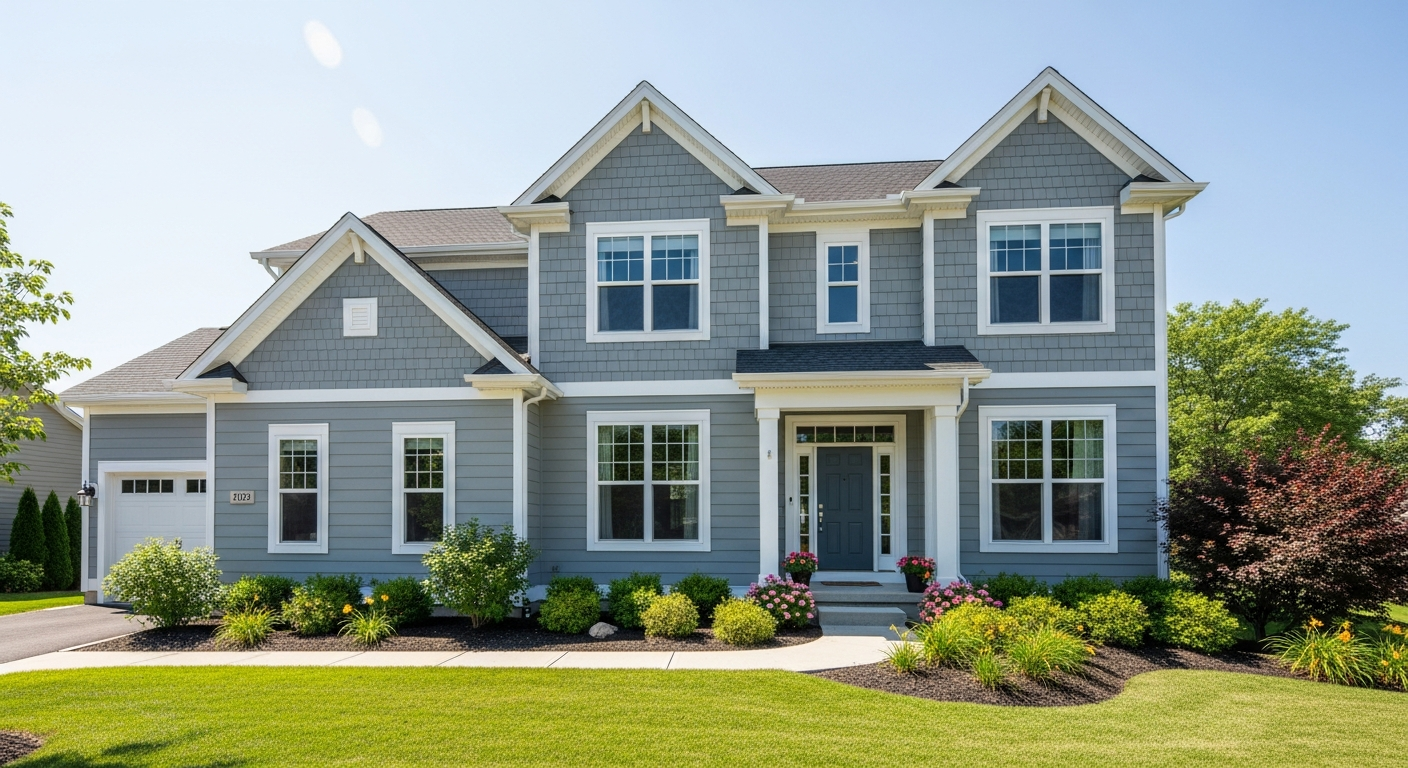
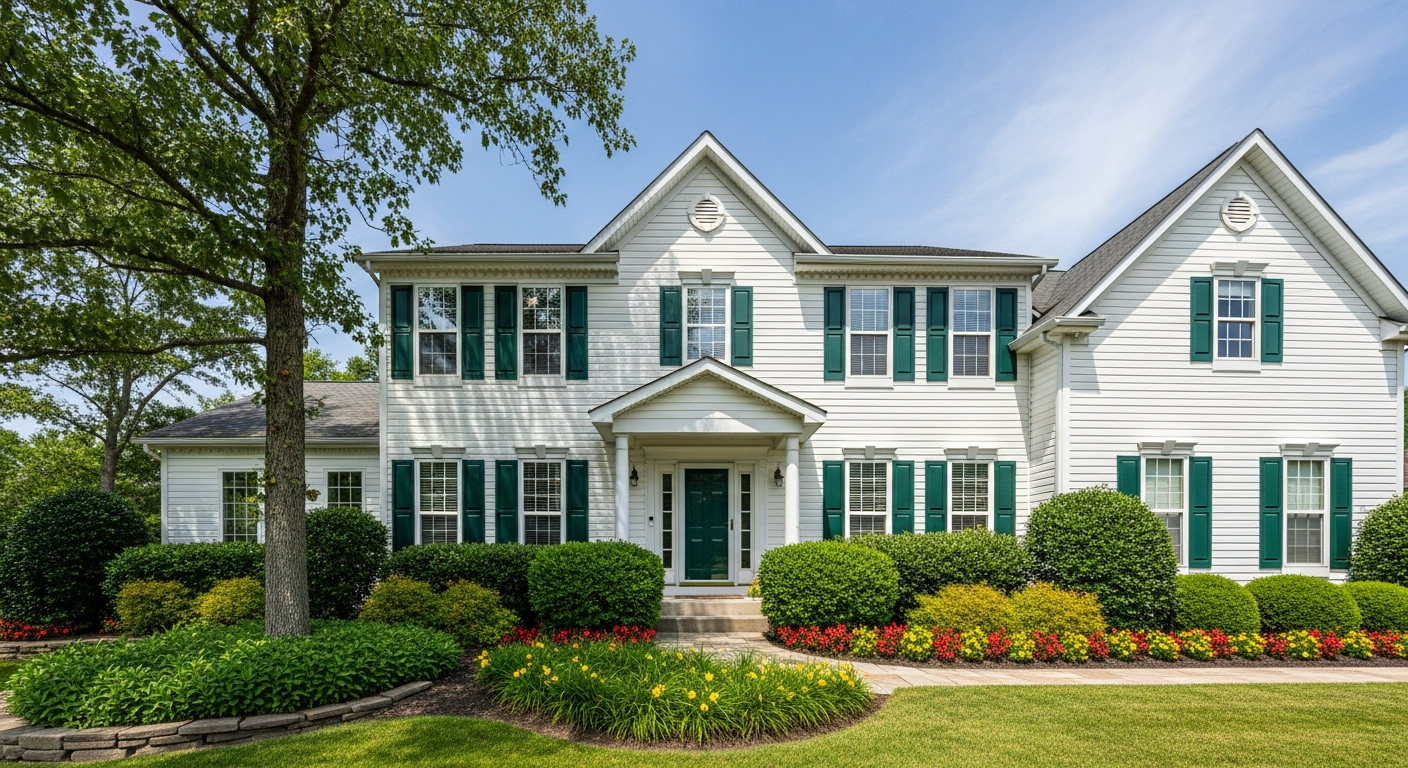
Drag the slider to compare Vinyl vs Hardie Board siding appearance
Vinyl Siding vs Hardie Board: Side-by-Side Comparison
Before the details, here is the full comparison. This table covers every factor that matters when you're choosing between vinyl siding and Hardie board fiber cement siding for your home's exterior:
| Factor | Vinyl Siding | Hardie Board (Fiber Cement) |
|---|---|---|
| Material | Polyvinyl chloride (PVC) | Cement, cellulose fibers, sand |
| Cost per sqft installed | $3.50–$7.00 | $6.50–$14.00 |
| 2,000 sqft home cost | $7,000–$14,000 | $13,000–$28,000 |
| Lifespan | 20–40 years | 30–50 years |
| Warranty | 25 years–lifetime (limited) | 30-year non-prorated |
| Fire rating | Combustible — softens/melts in heat | Class A (non-combustible) |
| Warping in heat | Can warp, buckle, or melt | Dimensionally stable — won't warp |
| Cold-weather behavior | Can become brittle and crack | Stable — minimal cracking |
| Maintenance | Rinse occasionally; no repainting | Repaint every 10–15 years |
| Weight | ~0.3–0.5 lb/sqft (light) | ~2.5 lbs/sqft (heavy) |
| Curb appeal | Good — improving textures | Premium — pressed wood grain |
| R-value (insulation) | ~0.61 standard; ~2–3 insulated | ~0.50 per inch |
| Noise reduction | Minimal | Better — dense, heavy material |
| Resale ROI | ~75–80% | ~70–80% |
| Best for | Budget, low maintenance, mild climates | Durability, fire zones, curb appeal, resale |
Source: James Hardie Industries, NAHB Construction Cost Reports, Remodeling Magazine Cost vs. Value Report, BLS.
Cost Comparison: Vinyl vs Hardie Board Siding
The clearest difference between these two materials is upfront cost. Vinyl siding costs $3.50–$7.00 per square foot installed, putting a typical 2,000-square-foot home at $7,000–$14,000. Hardie board runs $6.50–$14.00/sqft installed, or $13,000–$28,000 for the same home. On average, Hardie board costs about twice as much as vinyl siding at installation — a real difference of $6,000–$14,000 on most homes.
That gap narrows when you look past the upfront cost. Vinyl siding never needs repainting, but it typically needs replacing sooner, and a faded or cracked vinyl exterior drags down curb appeal. Hardie board costs more to install and adds a repaint every 10–15 years (roughly $5,000–$8,000 per cycle), but it lasts longer, holds its appearance, and returns more at resale. For homeowners weighing long-term value rather than the cheapest possible quote, the total cost of ownership is closer than the sticker price suggests.
| Home Size | Vinyl Siding (Installed) | Hardie Board (Installed) |
|---|---|---|
| 1,500 sqft | $5,250–$10,500 | $9,750–$21,000 |
| 2,000 sqft | $7,000–$14,000 | $13,000–$28,000 |
| 2,500 sqft | $8,750–$17,500 | $16,250–$35,000 |
| 3,000 sqft | $10,500–$21,000 | $19,500–$42,000 |
Installed cost only. Use our vinyl siding cost and Hardie board cost calculators for state-specific pricing.
Cost of Ownership: Vinyl vs Hardie Board Over 30 Years
The sticker price is only part of the decision. Here is what each siding material actually costs to own over 30 years on a typical 2,000-square-foot home — including the repaint cycles Hardie board requires and the routine upkeep both materials need:
| Line Item (2,000 sqft home) | Vinyl Siding | Hardie Board |
|---|---|---|
| Upfront installation | ~$10,000 | ~$20,000 |
| Repainting over 30 years | $0 | ~$6,500 (2 cycles) |
| Cleaning & minor upkeep | ~$500 | ~$500 |
| 30-year total spend | ~$10,500 | ~$27,000 |
| Lifespan remaining at year 30 | Near end of life | Mid-life (30–50 yr) |
| Resale recovery on install cost | ~75–80% | ~70–80% |
Illustrative example using national-average installed costs. Actual figures vary by state, home complexity, and product line.
On a pure-spend basis, vinyl siding is the cheaper material to own — roughly $10,500 over 30 years against about $27,000 for Hardie board. But push the horizon toward 40 years and the math shifts: vinyl typically reaches the end of its life and needs replacing, adding a second full installation, while Hardie board is still in service — and Hardie's stronger curb appeal recovers more absolute dollars at resale. Over a full ownership lifetime, the gap is closer than the roughly 2x difference in the upfront quote suggests, and that is the real case for paying more for Hardie board (fiber cement siding).
Hardie Board Siding: What Makes It Different
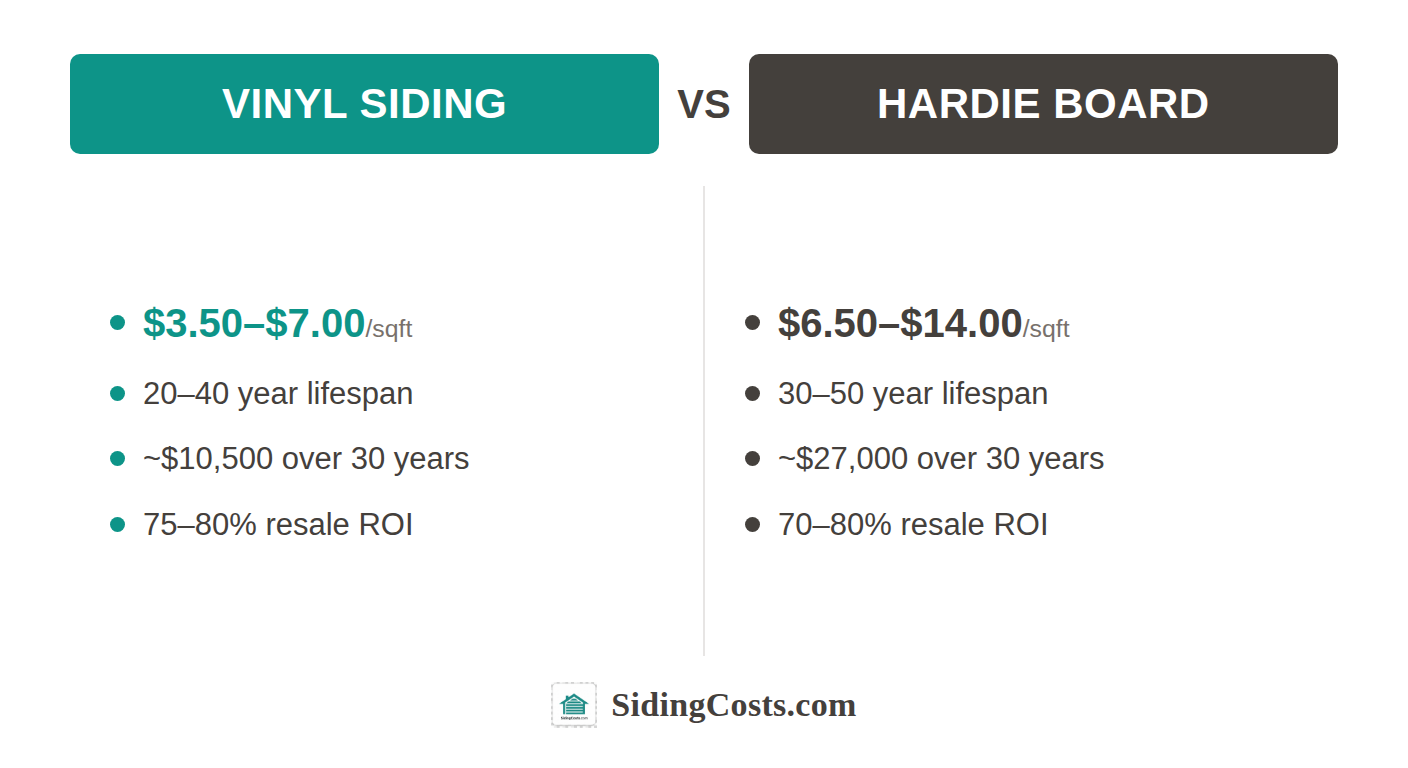
Vinyl siding vs Hardie board: key cost and performance metrics compared. Source: James Hardie Industries, NAHB, Remodeling Magazine.
Hardie board is the brand name for fiber cement siding made by James Hardie Industries, which holds roughly 90% of the North American fiber cement market — so "Hardie board" has become shorthand for the category. It is made from Portland cement, sand, and cellulose fibers. That cement matrix makes James Hardie siding non-combustible, immune to termites and rot, and dimensionally stable: it will not warp, swell, or buckle as temperatures swing the way some siding materials do.
Hardie board comes in several profiles, including HardiePlank lap siding, HardieShingle, and HardiePanel vertical siding. The Select Cedarmill texture is the most popular finish — a pressed wood grain pattern designed to mimic the look of natural cedar. From the curb it reads as real wood; up close it lacks some of the depth of natural grain, but it delivers premium curb appeal with far less upkeep. The ColorPlus technology factory finish is baked on at the plant and carries a 15-year finish warranty, while the substrate is warranted for 30 years, non-prorated.
Vinyl Siding: The Popular, Budget-Friendly Choice
Vinyl siding is the most common siding material in the United States, and for good reason: it is inexpensive, installs quickly, and asks almost nothing of the homeowner. Vinyl siding is made from polyvinyl chloride (PVC), the same durable plastic used in pipes and window frames. It is colored all the way through, so minor scratches don't show, and it never needs repainting — a quick rinse with a garden hose is the entire maintenance routine.
Modern vinyl has come a long way on looks. Manufacturers offer a wide range of colors, deeper wood-grain textures, and lap siding profiles that mimic the look of painted wood. Insulated vinyl siding adds a foam backing that boosts the R-value to roughly 2–3 and improves energy efficiency, closing some of the performance gap with premium materials. Vinyl's main weaknesses are heat and impact: because it is a thermoplastic, it can warp, buckle, or even melt under intense heat, and it can become brittle and crack in extreme cold or under a hard hailstrike.
Hardie Board Pros and Cons
Hardie Board Pros
- ✓ Class A fire rating — non-combustible, won't melt
- ✓ 30–50 year lifespan with a 30-year warranty
- ✓ Dimensionally stable — won't warp, swell, or buckle
- ✓ Immune to termites, rot, and most pest damage
- ✓ Premium curb appeal — pressed wood grain texture
- ✓ Better noise reduction from its dense, heavy body
- ✓ Strong, predictable resale value
Hardie Board Cons
- ✗ Roughly double the upfront cost of vinyl siding
- ✗ Heavy (2.5 lbs/sqft) — higher installation labor
- ✗ Needs a repaint every 10–15 years
- ✗ Cutting produces silica dust (safety gear required)
- ✗ Can crack if improperly installed
- ✗ Not biodegradable — ends up in landfill
Vinyl Siding Pros and Cons
Vinyl Siding Pros
- ✓ Lowest upfront cost of any durable siding
- ✓ Virtually no maintenance — no repainting, ever
- ✓ Lightweight — fast, low-labor installation
- ✓ Wide range of colors and profiles
- ✓ Color runs through — scratches don't show
- ✓ Insulated vinyl siding improves energy efficiency
- ✓ Strong resale ROI for the low investment
Vinyl Siding Cons
- ✗ Can warp, buckle, or melt in intense heat
- ✗ Becomes brittle and can crack in extreme cold
- ✗ Combustible — no fire rating
- ✗ Shorter lifespan (20–40 years)
- ✗ Water can get behind it if flashing fails
- ✗ Lower-end products can look flat up close
Durability and Long-Term Value: Which Siding Lasts Longer?
Hardie board lasts longer. Fiber cement siding is rated for 30–50 years and backed by a 30-year non-prorated warranty, while vinyl siding lasts 20–40 years. The difference comes down to how each material handles stress. Hardie board is dimensionally stable, so it won't warp, cup, or pull loose as the seasons change. Vinyl is a thermoplastic: in extreme heat it can warp or buckle, and in deep cold it grows brittle and can crack on impact. In mild and moderate climates a quality vinyl product holds up well; in regions with wide temperature swings, Hardie board's stability translates directly into long-term value.
Maintenance shapes the long-term picture too. Vinyl asks for almost nothing — no repainting and an occasional rinse. Hardie board needs a repaint every 10–15 years, though the ColorPlus factory finish stretches that interval and many owners go a full 15 years between repaints. Neither material demands the staining cycle that natural wood siding requires, so both are low-maintenance compared to cedar.
One detail homeowners often miss: water can get behind vinyl siding. Vinyl hangs loosely and is designed to shed water, not seal it out, relying on the house wrap behind it to keep moisture from the sheathing. Wind-driven rain can work its way behind the panels, which is why correct flashing and a quality weather-resistant barrier are essential during siding installation. Hardie board is moisture-resistant and installed tighter, but it depends on proper flashing just the same.
Fire Resistance, Energy Efficiency, and Extreme Weather
Fire resistance is the most one-sided category. Hardie board carries a Class A fire rating — the highest available — because cement does not burn. It will not ignite, spread flame, or melt. Vinyl siding is combustible and, because it is made from polyvinyl chloride, it softens and can melt at temperatures well below open flame: heat from a nearby grill, or sunlight reflected off energy-efficient low-E windows, has been known to warp vinyl. In wildfire-prone areas of California, Colorado, and Oregon, building codes increasingly require non-combustible siding, and Hardie board meets that standard while vinyl does not.
For extreme weather more broadly, Hardie board resists hail, high wind, and freeze-thaw cycles better than vinyl. On energy efficiency, standard vinyl is a modest insulator (R-value around 0.61), but insulated vinyl siding with a foam backing reaches roughly R-2 to R-3 and can meaningfully cut heating and cooling bills — an area where vinyl can actually outperform standard Hardie board, which sits near R-0.50 per inch. Hardie board's denser body does give it an edge in noise reduction, dampening outside sound more than a hollow vinyl panel.
Curb Appeal and Resale Value
Curb appeal is where Hardie board justifies its price for many homeowners. The thicker profile, deeper shadow lines, and pressed wood grain read as a premium, custom exterior, and buyers tend to perceive a fiber-cement home as higher quality. Vinyl's aesthetics have improved markedly — better textures, richer colors, and architectural profiles — but the lowest-cost products can still look flat next to Hardie board up close.
Both materials return strong value at resale. According to Remodeling Magazine's Cost vs. Value Report, vinyl siding recovers roughly 75–80% of its cost and fiber cement siding 70–80%. Because Hardie board costs more to install, the dollar figure recovered is larger even at a similar percentage, and its premium look can lift a home's sale price. Vinyl delivers the better return relative to its low upfront cost. In practice, the condition of the siding at sale matters more than the material — a clean, well-kept vinyl exterior beats neglected Hardie board every time. For a full picture of how siding affects value, see our house siding cost guide.
Choosing the Right Siding for Your Home
Choose vinyl siding if upfront cost and low maintenance are your priorities, you live in a mild or moderate climate, and you want a strong return without a premium investment. Vinyl is the practical pick for budget-conscious homeowners, rental properties, and anyone who'd rather rinse their siding once a year than repaint it. Insulated vinyl siding is worth the upgrade if energy efficiency matters in your region.
Choose Hardie board (fiber cement siding) if you want maximum durability, fire resistance, and curb appeal, and you plan to stay in the home long enough to value its longevity. Hardie board is the right siding material for fire-prone and storm-prone regions, homes in neighborhoods where a premium exterior affects resale, and owners who want a siding they won't think about for decades. The repaint every 10–15 years is the main ongoing commitment.
If you want something between these two — more curb appeal than vinyl, less cost than Hardie board — look at LP SmartSide engineered wood siding at $4.50–$9.00/sqft installed. It splits the difference, offering a realistic wood look at a mid-range price. Whatever you choose, get three or more quotes; contractor pricing for the same siding material varies 20–40% in the same market.
Frequently Asked Questions
Is Hardie board better than vinyl siding?+
Is Hardie board more expensive than vinyl?+
How long does vinyl siding last compared to Hardie board?+
Which siding requires less maintenance?+
Can water get behind vinyl siding?+
Does vinyl siding melt or warp?+
Which siding adds more value at resale?+
Which siding is better for extreme climates?+
Compare Costs for Your Home
Use our free calculators for state-specific estimates on both materials.
Related Siding Comparisons
Vinyl vs Fiber Cement
Vinyl vs the broader category
Hardie Board vs Cedar
Premium vs premium
Vinyl vs Wood Siding
Budget vs natural wood
Vinyl vs Metal
Budget vs durability
Data Sources & Methodology
📊Bureau of Labor Statistics (BLS) — Occupational Employment and Wage Statistics (OEWS), OCC 47-2211 & 47-2031
🏠National Association of Home Builders (NAHB) — Construction Cost Survey, 2024-2026 data
🏭James Hardie Corp — Published product pricing and warranty specifications
🌲Western Red Cedar Bureau — Cedar siding grade pricing and specifications
🔧Active contractor pricing surveys — 50-state coverage, updated quarterly
All cost data is updated quarterly. Last comprehensive update: Q1 2026.
Home Exterior Cost Analyst
Sarah Brennan
Sarah Brennan is a construction cost researcher specializing in exterior building envelope systems. With 14 years of experience in residential construction estimating, she transitioned from managing siding installation crews to independent cost research. Her data draws from the Bureau of Labor Statistics, NAHB construction cost reports, manufacturer pricing databases, and active contractor surveys across all 50 states. Sarah is a Certified Construction Specifier (CCS) through the Construction Specifications Institute.
Important Disclaimer
The cost estimates provided by SidingCosts.com are for informational and educational purposes only. Actual siding costs vary based on local labor rates, material availability, site conditions, contractor pricing, and other factors not captured by this calculator. These estimates should not be used as a substitute for professional contractor quotes. SidingCosts.com is not a licensed contractor and does not provide installation services. Always obtain at least 3 written quotes from licensed, insured contractors in your area before starting any siding project. Data sources include the Bureau of Labor Statistics (BLS), National Association of Home Builders (NAHB), and manufacturer published pricing. Last updated: 2026.