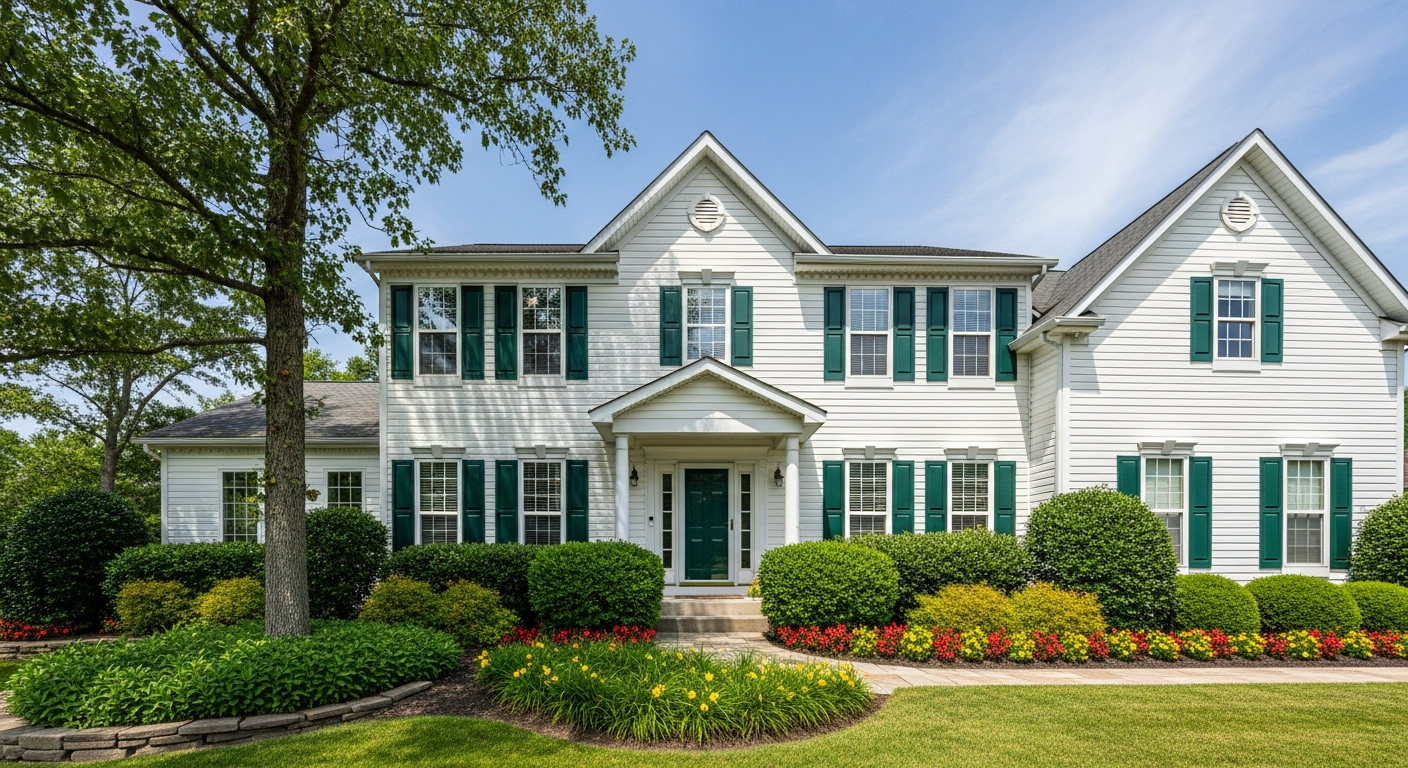
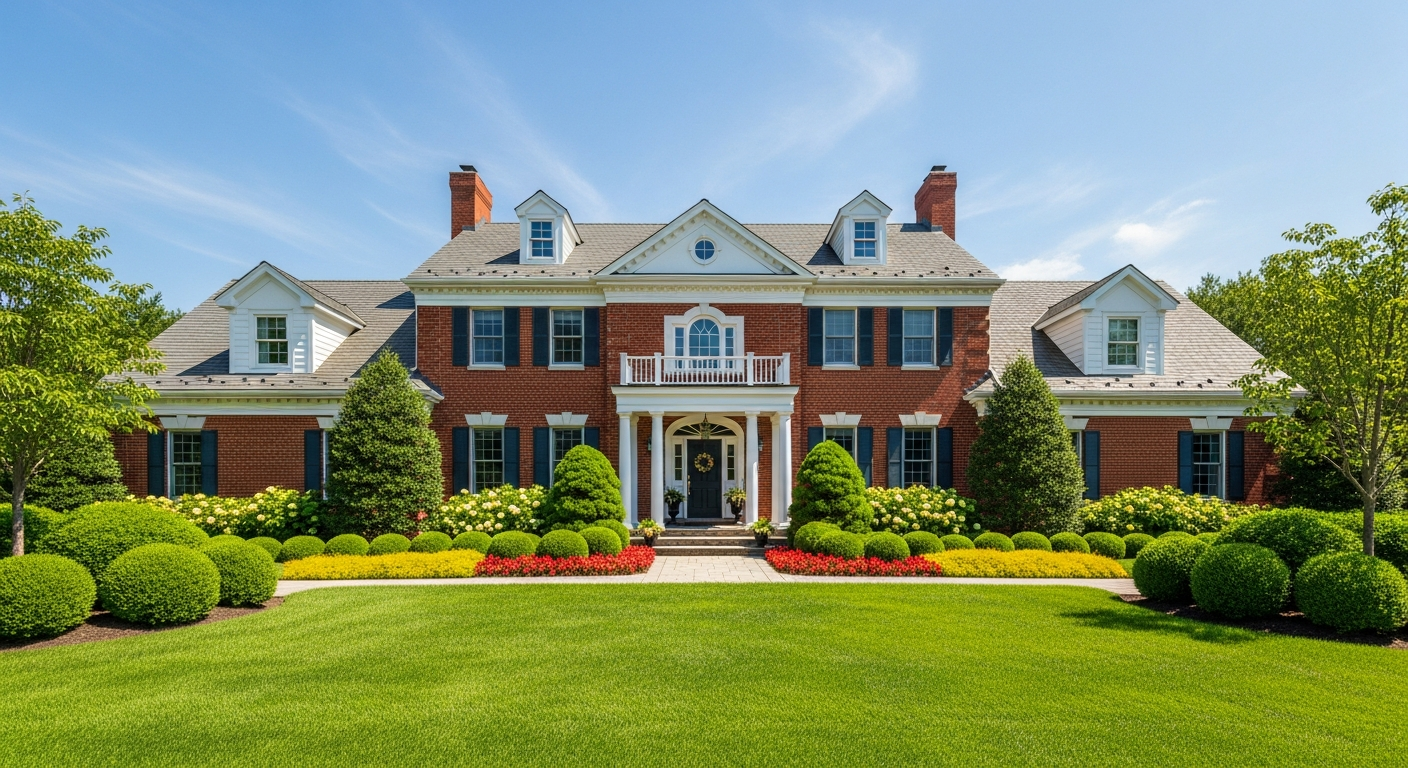
Drag the slider to compare Brick vs Siding siding appearance
Brick vs Siding: Side-by-Side Comparison
Here is the full comparison before the details. This table weighs brick against siding — represented here by vinyl, the most common siding material — across every factor that matters for your home's exterior:
| Factor | Siding (Vinyl) | Brick (Veneer) |
|---|---|---|
| Material | Polyvinyl chloride (PVC) | Fired clay brick & mortar |
| Cost per square foot installed | $3.50–$7.00 | $9.00–$18.00 |
| 2,000 sqft home cost | $7,000–$14,000 | $18,000–$36,000 |
| Lifespan | 20–40 years | 75–100+ years |
| Maintenance | Rinse occasionally; no painting | Very low; occasional repointing |
| Installation | DIY-friendly; fast | Skilled masons; slow |
| Fire rating | Combustible | Non-combustible (Class A) |
| Weather & impact | Can crack in hard impact | Excellent — resists wind, hail |
| Rot & insect resistance | Immune — won't rot | Immune — won't rot |
| Energy (insulation) | ~0.61 std; ~2–3 insulated | Low R-value; high thermal mass |
| Color options | Wide range; not repainted | Fixed; can be painted |
| Curb appeal | Good — many profiles | Premium — timeless classic |
| Resale value | ~75–80% recovery | Strong — buyers pay for brick |
| Best for | Budget, low maintenance, flexibility | Longevity, resale, forever homes |
Source: Brick Industry Association, NAHB Construction Cost Reports, Remodeling Magazine Cost vs. Value Report, BLS.
Cost Comparison: Brick vs Siding
On upfront cost, siding wins decisively. Vinyl siding costs $3.50–$7.00 per square foot installed — $7,000–$14,000 on a typical 2,000-square-foot home. Brick veneer runs $9.00–$18.00 per square foot, or $18,000–$36,000 for the same home, because brick is a slow, labor-intensive install requiring skilled masons rather than a panel a crew can hang in a day. Brick is one of the most expensive exteriors you can choose, often 2–3 times the cost of vinyl siding.
But the upfront cost only tells part of the story. Brick lasts two to four times as long as vinyl siding — 75–100+ years against 20–40 — and asks almost nothing in maintenance along the way. So while siding wins the quote, brick wins the decades. The right way to read the cost of brick vs siding is per generation, not per square foot, which is exactly what the 30-year ownership view shows next.
| Home Size | Siding (Vinyl) Installed | Brick (Veneer) Installed |
|---|---|---|
| 1,500 sqft | $5,250–$10,500 | $13,500–$27,000 |
| 2,000 sqft | $7,000–$14,000 | $18,000–$36,000 |
| 2,500 sqft | $8,750–$17,500 | $22,500–$45,000 |
| 3,000 sqft | $10,500–$21,000 | $27,000–$54,000 |
Installed cost only. Use our vinyl siding cost and all-materials cost calculators for state-specific pricing.
Cost of Ownership: Brick vs Siding Over 30 Years
Here is what each exterior actually costs to own over 30 years on a typical 2,000-square-foot home. Brick's advantage is that, unlike most exteriors, it asks for almost nothing once it's up:
| Line Item (2,000 sqft home) | Siding (Vinyl) | Brick (Veneer) |
|---|---|---|
| Upfront installation | ~$10,000 | ~$27,000 |
| Repainting / refinishing over 30 years | $0 | $0 |
| Cleaning, repointing & repair | ~$500 | ~$2,000 |
| 30-year total spend | ~$10,500 | ~$29,000 |
| Lifespan | 20–40 years | 75–100+ years |
| Resale recovery on install | ~75–80% | ~70–85% |
Illustrative example using national-average costs. Actual figures vary by region, brick type, and home complexity.
Over 30 years, siding is the cheaper exterior — roughly $10,500 against $29,000 for brick. But the lifespan row is brick's whole argument: at year 30, vinyl siding is nearing the end of its life and facing replacement, while a brick home is barely a third of the way through its. Stretch the horizon to 60 or 75 years and a homeowner re-sides two or three times over the same brick wall — at which point brick's cost per decade is competitive, and you've never repainted it once. That makes brick a forever-home, buy-it-once investment. If you'll move within a decade or two, siding is the smarter money.
What Is Brick Siding? Veneer vs Structural
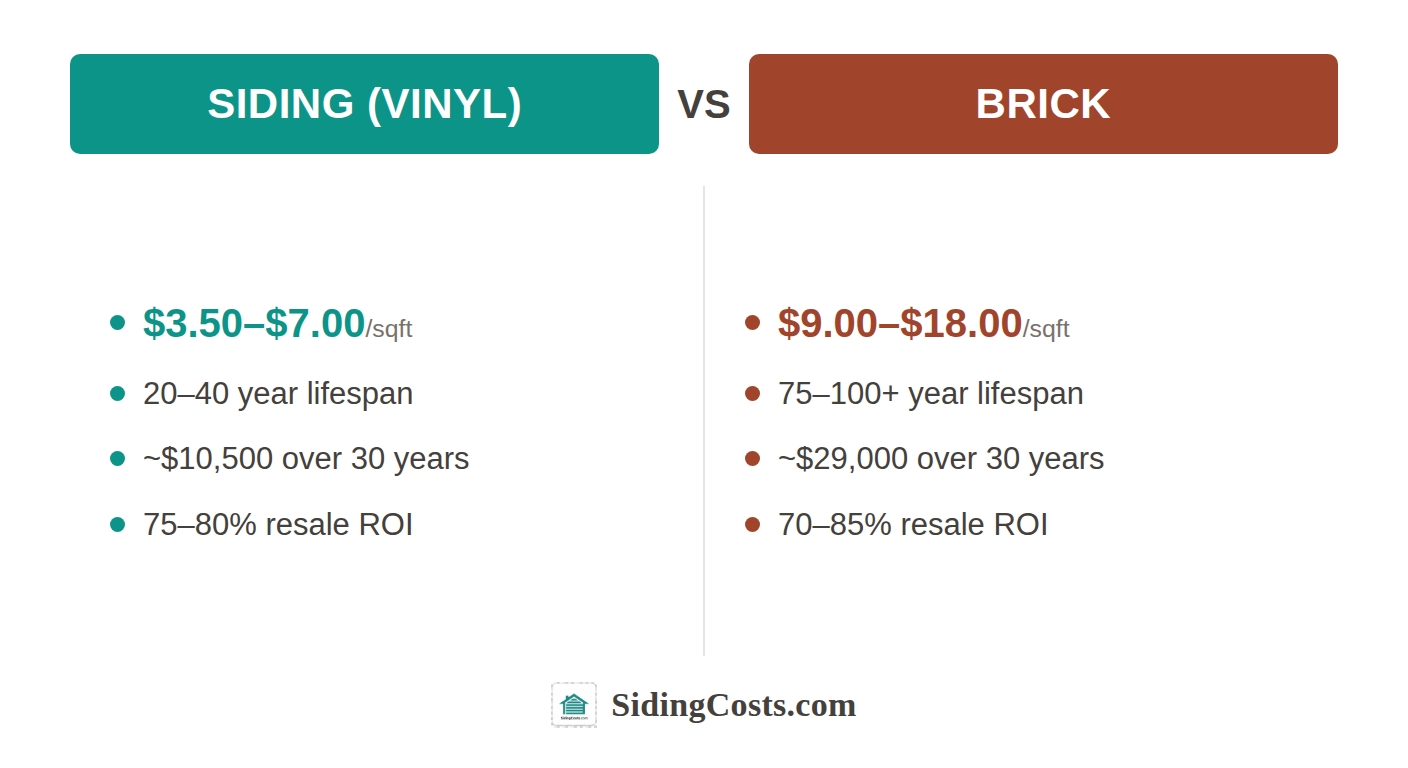
Brick vs siding: key cost and performance metrics compared. Source: Brick Industry Association, NAHB, Remodeling Magazine.
On nearly all modern homes, "brick" means brick veneer — a single decorative layer of fired clay brick laid over a wood-frame wall with an air gap behind it, anchored with metal ties. It is not structural; the wood frame carries the load while the brick handles the weather and the look. (Older homes sometimes have solid double-wythe brick that is structural, but that's rare in new construction.) Brick is made from natural clay fired in a kiln, set in mortar, and it is renowned for outlasting almost everything around it — a well-constructed brick home can last for generations.
Brick's appeal is its permanence and its timeless, classic curb appeal. It won't rot, won't burn, resists insects, and shrugs off wind and hail. The tradeoffs are cost, weight, and flexibility: brick is expensive and slow to install, and once it's up the color is essentially permanent — you can paint brick, but it's a one-way decision most owners avoid — once painted, brick needs periodic repainting like any painted surface, trading away its no-maintenance advantage. Over decades, the mortar joints may need repointing, though in practice many homeowners never face it: quality mortar can go 25–50 years before it needs attention, while the brick itself effectively lasts the life of the house.
What Is Siding? Vinyl, Fiber Cement, and Wood
"Siding" is a category of panelized cladding, not a single material. Vinyl siding — made from polyvinyl chloride (PVC) — is the most common: versatile, affordable, and nearly maintenance-free, with a wide range of colors and profiles. It won't rot, never needs painting, and a homeowner can install it as a DIY project.
Beyond vinyl, the leading siding options are fiber cement siding (brands like James Hardie — durable, non-combustible, and the siding material that comes closest to brick on toughness and longevity), wood siding for natural character, and stone veneer for a masonry look. Some siding is even molded to mimic the appearance of brick at a fraction of the cost — though up close it rarely fools anyone. For homeowners drawn to brick's durability but not its price, fiber cement is the natural middle ground.
Brick Pros and Cons
Brick Pros
- ✓ 75–100+ year lifespan — lasts for generations
- ✓ Very low maintenance — no painting, rarely any repair
- ✓ Non-combustible and fire resistant
- ✓ Excellent weather, wind, and hail resistance
- ✓ Immune to rot and insects
- ✓ Timeless, premium curb appeal that adds home value
- ✓ High thermal mass moderates indoor temperature
Brick Cons
- ✗ Highest upfront cost of common exteriors
- ✗ Slow installation by skilled masons — not DIY
- ✗ Color is essentially permanent once installed
- ✗ Low R-value on its own; needs wall insulation
- ✗ Mortar may need repointing after decades
- ✗ Heavy — requires proper structural support
Siding Pros and Cons
Siding Pros
- ✓ Much lower upfront cost — especially vinyl
- ✓ Low maintenance — no repainting for vinyl
- ✓ Fast, often DIY-friendly installation
- ✓ Wide range of colors and styles; easy to change
- ✓ Won't rot; immune to insects
- ✓ Insulated vinyl siding improves energy efficiency
- ✓ Easy, inexpensive to repair or replace a panel
Siding Cons
- ✗ Shorter lifespan than brick (vinyl 20–40 yrs)
- ✗ Vinyl is combustible and can warp in heat
- ✗ Can crack under hard impact or hail
- ✗ Less premium curb appeal than brick
- ✗ Lower-end vinyl can look like plastic up close
- ✗ Premium siding (fiber cement) costs more
Durability and Longevity: How Long Each Lasts
Brick is built to outlast the people who choose it. A well-constructed brick exterior lasts 75–100 years and often far longer — many century-old brick homes are still on their original walls — versus 20–40 years for vinyl siding. Brick is non-combustible, immune to rot and insects, and stands up to wind, hail, and impact better than any common siding material. Its durability is the reason brick has passed the test of time as a building material for thousands of years.
Siding can't match brick on raw longevity, but it has its own advantages: a damaged vinyl or fiber cement panel is cheap and quick to replace, while repairing brick or matching aged mortar is a skilled, costly job. Fiber cement siding narrows the durability gap considerably, with a 30–50 year life and strong weather and fire resistance — the closest a panelized siding gets to brick's permanence. For most homeowners the question isn't whether brick lasts longer (it does), but whether that extra lifespan justifies two to three times the cost.
Energy Efficiency and Insulation
On energy, brick and siding compete on different terms. Brick has a low R-value on its own, but it has high thermal mass — it absorbs heat during the day and releases it slowly, which moderates indoor temperature and can trim heating and cooling bills in climates with large day-to-night temperature swings. Vinyl siding has little insulating value by itself, but insulated vinyl siding with a foam backing reaches R-2 to R-3 and can match or beat brick veneer on pure insulation.
In real homes, the biggest factor for both is the wall insulation behind the cladding, not the cladding itself — a well-insulated wood-frame wall drives energy efficiency whether it's finished with brick or siding. Brick's thermal mass is a meaningful bonus in hot, dry, or high-desert climates; in milder zones the difference between the two is small once the wall behind is properly insulated.
Can You Combine Brick and Siding?
Yes — and combining brick and siding is one of the most popular ways to balance cost and curb appeal. A very common approach is brick on the front façade or the lower level, where it makes the strongest visual impression and adds the most value, with vinyl or fiber cement siding on the sides and rear to control the budget. Done well, the home reads as a brick house from the street at a fraction of a full brick exterior's cost. This brick-front, siding-elsewhere pattern is the default across much of modern subdivision construction, where production builders use it to hit a price point while keeping the street-facing curb appeal buyers respond to. Mixing brick with siding also lets you add texture and architectural interest — gables in siding above a brick base, for example.
You can also install siding over existing brick using furring strips and rigid foam to create a flat, insulated nailing surface, which is a route some homeowners take to modernize or cover damaged brick. More often, though, brick is the material people keep precisely for its durability and value — it's siding that gets swapped out, not brick.
Why Don't People Build Brick Houses Anymore?
They still do — just differently. Most new "brick" homes use brick veneer rather than the solid, double-wythe structural brick of a century ago. The shift came down to cost, speed, and energy codes: solid brick is expensive and slow to lay, and a solid masonry wall is a poor insulator by modern standards. Insulated wood-frame construction is faster and cheaper to build and far easier to insulate, so builders frame the wall, insulate it, and finish it with brick veneer or siding.
So brick didn't disappear — it became a premium veneer option that delivers the look and durability of brick on a modern, well-insulated wall. The rise of affordable vinyl and the speed of siding installation simply gave builders and buyers a lower-cost alternative, which is why siding now wraps the majority of new homes while brick has become the upgrade.
Choosing the Right Exterior for Your Home
Choose brick if longevity, low maintenance, fire resistance, and a timeless look matter more than upfront cost, and you plan to stay in the home long-term. Brick is the right exterior for forever homes, buyers who want maximum resale value and curb appeal, and anyone who wants to install once and never think about the exterior again. The cost is real, but so is the century it can last.
Choose siding if upfront cost, flexibility, and easy maintenance are your priorities, or you may move within a decade or two. Vinyl siding is the affordable, versatile default; fiber cement is the durable upgrade for homeowners who want brick-like toughness without brick pricing. And if you love the look of brick but not the budget, combining brick and siding — or choosing fiber cement — gets you most of the way there. Whatever you pick, get three or more quotes; pricing for the same material varies 20–40% within a single market.
Frequently Asked Questions
Is it cheaper to build with brick or siding?+
Does brick or siding add more value to a home?+
How long does brick last vs siding?+
Is brick or siding more energy efficient?+
Can you combine brick and siding on a house?+
Can siding be installed over existing brick?+
Why don't people build brick houses anymore?+
Which is more weather and fire resistant?+
Compare Costs for Your Home
Use our free calculators for state-specific exterior estimates.
Related Siding Comparisons
Stucco vs Siding
The other masonry exterior
Vinyl vs Fiber Cement
The brick-tough siding option
Vinyl vs Hardie Board
Budget vs premium fiber cement
Stone Veneer Cost
Premium masonry pricing
Data Sources & Methodology
📊Bureau of Labor Statistics (BLS) — Occupational Employment and Wage Statistics (OEWS), OCC 47-2211 & 47-2031
🏠National Association of Home Builders (NAHB) — Construction Cost Survey, 2024-2026 data
🏭James Hardie Corp — Published product pricing and warranty specifications
🌲Western Red Cedar Bureau — Cedar siding grade pricing and specifications
🔧Active contractor pricing surveys — 50-state coverage, updated quarterly
All cost data is updated quarterly. Last comprehensive update: Q1 2026.
Home Exterior Cost Analyst
Sarah Brennan
Sarah Brennan is a construction cost researcher specializing in exterior building envelope systems. With 14 years of experience in residential construction estimating, she transitioned from managing siding installation crews to independent cost research. Her data draws from the Bureau of Labor Statistics, NAHB construction cost reports, manufacturer pricing databases, and active contractor surveys across all 50 states. Sarah is a Certified Construction Specifier (CCS) through the Construction Specifications Institute.
Important Disclaimer
The cost estimates provided by SidingCosts.com are for informational and educational purposes only. Actual siding costs vary based on local labor rates, material availability, site conditions, contractor pricing, and other factors not captured by this calculator. These estimates should not be used as a substitute for professional contractor quotes. SidingCosts.com is not a licensed contractor and does not provide installation services. Always obtain at least 3 written quotes from licensed, insured contractors in your area before starting any siding project. Data sources include the Bureau of Labor Statistics (BLS), National Association of Home Builders (NAHB), and manufacturer published pricing. Last updated: 2026.