What's the Average Cost of Vinyl Siding Per Square Foot?
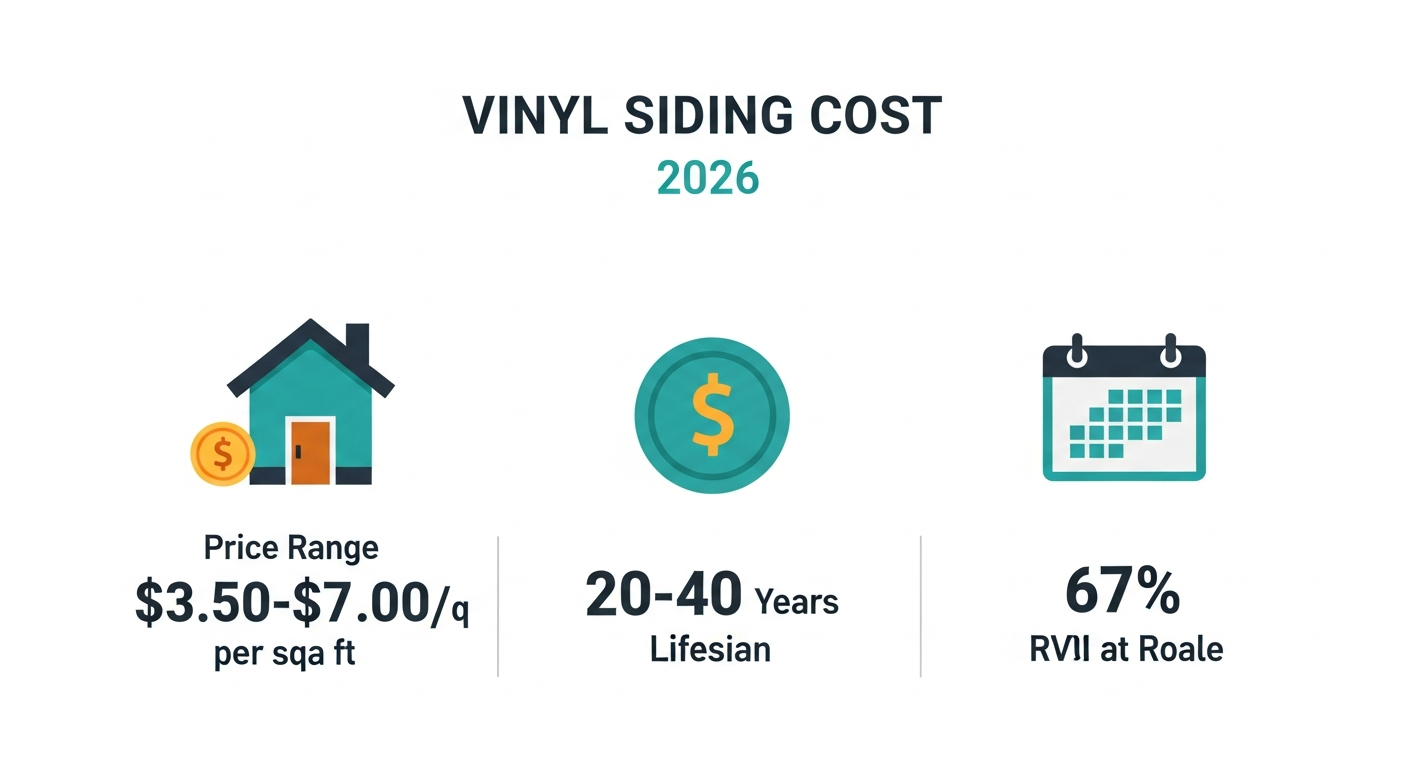
Vinyl siding costs between $3.50 and $7.00 per square foot for a fully installed project in 2026. That price includes both the vinyl panels themselves and professional installation labor. The material alone — just the siding panels, starter strips, J-channel, and corner posts — runs about $1.50 to $3.50 per square foot. The rest covers labor, which typically accounts for around 45% of the total vinyl siding cost.
Why such a wide range? It comes down to the grade of vinyl you choose, where you live, and how complex your house is to side. A basic builder-grade installation on a simple ranch home in Mississippi will land near that $3.50 floor. A premium insulated vinyl siding installation on a two-story colonial in Massachusetts with dormers and multiple gable ends will push toward $7.00 or higher per square foot.
To put those numbers in context: vinyl siding made from polyvinyl chloride (PVC) remains the single most popular exterior cladding in America. According to the U.S. Census Bureau, roughly 27% of new single-family homes built in 2023 used vinyl siding — more than any other material. The reason is straightforward. No other siding option delivers this combination of low upfront cost, minimal maintenance, and decent durability at this price point.
Vinyl Siding Cost by Home Size
The fastest way to ballpark your vinyl siding cost is by home size. The table below shows installed cost ranges for standard-grade vinyl at national average labor rates. If you need a state-specific estimate, use the siding cost calculator at the top of this page.
| Home Size | Siding Area (approx.) | Low Estimate | High Estimate | Midpoint |
|---|---|---|---|---|
| 1,000 sq ft (small ranch) | ~1,000 sq ft | $3,500 | $7,000 | $5,250 |
| 1,200 sq ft | ~1,200 sq ft | $4,200 | $8,400 | $6,300 |
| 1,500 sq ft | ~1,500 sq ft | $5,250 | $10,500 | $7,875 |
| 2,000 sq ft (average home) | ~2,000 sq ft | $7,000 | $14,000 | $10,500 |
| 2,500 sq ft | ~2,450 sq ft | $8,575 | $17,150 | $12,863 |
| 3,000 sq ft (large home) | ~2,950 sq ft | $10,325 | $20,650 | $15,488 |
Source: NAHB construction cost data, BLS OEWS. Standard vinyl, national average labor rates. Includes materials, labor, and basic trim. Does not include old siding removal.
A couple of notes on these numbers. “Siding area” is not the same as your home's living space square footage. For a single-story ranch, the siding area is roughly equal to the floor area. For a two-story home, the siding area per floor square foot actually decreases because the footprint is smaller relative to the total living space. That's why a 3,000-square-foot two-story doesn't need 3,000 square feet of siding — it needs closer to 2,950.
Vinyl Siding Cost Per Square Foot: Materials vs. Labor
Understanding where your money goes helps you negotiate smarter quotes. Here's how the average vinyl siding cost per square foot breaks down:
| Cost Component | Per Sq Ft (Low) | Per Sq Ft (High) | % of Total |
|---|---|---|---|
| Vinyl siding panels | $1.00 | $2.50 | 30–35% |
| Trim, J-channel, corners, soffit | $0.50 | $1.00 | 10–15% |
| House wrap / moisture barrier | $0.15 | $0.30 | 3–5% |
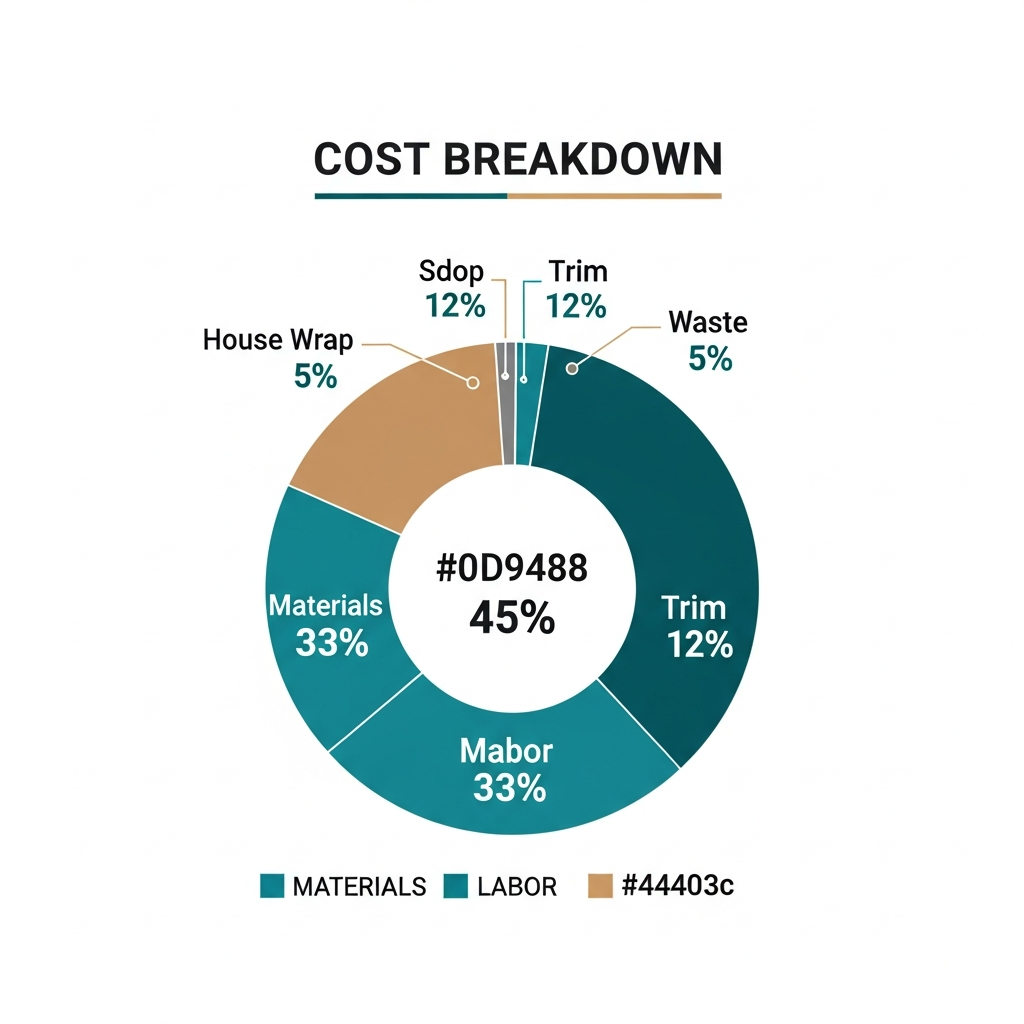
| Installation labor | $1.50 | $2.75 | 40–45% |
| Waste / overage (10–15%) | $0.20 | $0.45 | 5–7% |
| Total installed | $3.50 | $7.00 | 100% |
Labor is the biggest single line item. The national median hourly wage for siding installers sits around $24 to $28 per hour according to the Bureau of Labor Statistics (BLS), but that's the employee rate. What a contractor charges the homeowner includes overhead, insurance, profit margin, and transport — which pushes the effective rate to $40 to $75 per hour depending on your market. A two-person crew can typically install 300 to 500 square feet of vinyl siding per day, depending on the complexity of the house.
Labor Cost to Install Vinyl Siding
Labor cost to install vinyl siding varies significantly by region. Contractors in high-cost-of-living states like Massachusetts, Connecticut, New Jersey, and California charge 25–30% more than the national average. Meanwhile, labor in states like Mississippi, Arkansas, West Virginia, and Alabama runs 20–28% below the national average.
Here's what drives labor pricing beyond geography: the number of stories on your home (scaffolding adds cost), the number of windows and doors that need trim wrapping, whether your home has dormers or complex rooflines, and the time of year. Most siding contractors see peak demand from late spring through early fall. If your schedule allows, booking a vinyl siding installation in late fall or early winter can sometimes save 10–15% on labor — though this depends on your climate and the contractor's workload.
One thing worth calling out: vinyl siding is considered one of the easier siding materials to install, which keeps the labor cost per square foot lower than alternatives like fiber cement siding or cedar siding. Fiber cement, for example, is heavier, requires special cutting tools, and generates silica dust that demands respiratory protection. That extra complexity pushes fiber cement labor costs 30–50% higher than vinyl.
Vinyl Siding Cost by Grade
Not all vinyl siding is created equal. The grade — essentially the thickness and quality of the manufacturing — has a major impact on both the installed price and how long the siding will last. Here's how the three main grades compare:
| Grade | Thickness | Cost/Sq Ft (Installed) | Lifespan | Best For |
|---|---|---|---|---|
| Builder / Economy | .040" | $3.50–$5.00 | 15–25 yrs | Rental properties, budget flips |
| Mid-Grade / Standard | .044" | $4.50–$6.00 | 20–35 yrs | Most homeowners |
| Premium / Architectural | .046–.050" | $5.50–$7.00 | 25–40 yrs | Curb appeal, long-term homes |
| Insulated Vinyl | Foam-backed | $5.00–$9.00 | 25–40 yrs | Energy efficiency, cold climates |
The difference between .040" and .046" thickness might not sound like much, but it's significant in practice. Thicker vinyl panels resist impact damage better (important in areas prone to hail), hold their color longer under UV exposure, and are far less likely to warp in extreme heat. Most siding professionals recommend .044" as the minimum for a primary residence.
Insulated vinyl siding deserves special attention if energy efficiency matters to you. These panels have a rigid foam backing that fills the gap between the siding and the wall sheathing, boosting the wall's R-value by 2.0 to 2.7 points. For homes in cold climates where heating costs are a concern, that added building insulation can reduce annual energy bills by 5–10% — though the payback period depends on your local energy prices and how well-insulated the rest of the house is. Brands like CertainTeed Cedar Impressions, Alside Prodigy, and Ply Gem Mastic Structure lead the insulated vinyl market.
Comparing Vinyl Siding Costs by Style
Beyond grade, the profile style you choose affects the price. Traditional horizontal lap siding (the classic look most people picture) is the most affordable. Vertical board and batten, shingle-style, and Dutch lap profiles cost more due to more complex manufacturing and slightly slower installation.
| Style | Cost/Sq Ft (Installed) | Look |
|---|---|---|
| Horizontal Lap (Double 4" or 5") | $3.50–$6.00 | Classic, most common |
| Dutch Lap | $4.00–$6.50 | Shadow line, slightly more dimension |
| Board & Batten (Vertical) | $4.00–$8.00 | Modern farmhouse |
| Shake / Shingle | $5.00–$8.00 | Cedar shake look, Cape Cod style |
| Beaded | $4.50–$7.00 | Traditional, Southern coastal |
Many homeowners mix styles — horizontal lap on the main walls with shake accents on gable ends, for example. This adds visual interest without dramatically increasing the budget. If you're comparing vinyl board and batten against other materials, check our board and batten siding cost guide for a full breakdown.
Factors Affecting Vinyl Siding Installation Cost
When contractors quote a vinyl siding project, several factors push the price up or down from the national average. Understanding these helps you anticipate where your project will land in the range.
Home Size and Siding Area
This is the most obvious driver. More square footage means more material and more labor hours. But larger projects sometimes get a slight per-square-foot discount because the contractor's fixed costs (mobilization, setup, permits) get spread across more area.
Number of Stories
A two-story home costs more per square foot to side than a single-story home because installers need scaffolding or ladders, which slows the work and increases the safety requirements. Expect a 10–15% premium for two stories and 15–20% for three.
Architectural Complexity
Windows, doors, dormers, bump-outs, inside corners, and decorative trim all slow installation. A simple rectangular ranch with six windows is dramatically faster to side than a Victorian with 20 windows, three dormers, and multiple roof transitions. Contractors typically apply a complexity multiplier of 1.0x for simple homes, 1.15x for moderate, and 1.30x for complex.
Old Siding Removal
If you're replacing existing siding rather than siding new construction, the old material needs to come off first. Removing old vinyl or aluminum siding adds $0.50 to $1.25 per square foot. Removing wood siding costs $1.00 to $2.00 per square foot. And if your home has asbestos siding (common in homes built before 1980), professional abatement runs $3.00 to $8.00 per square foot — a significant addition to the project budget. See our siding replacement cost guide for full removal pricing.
Geographic Location
Labor rates swing the total cost significantly. Using BLS regional wage data for siding installers, here are some examples: installing vinyl siding in California costs roughly 30% more than the national average due to higher labor rates. In Massachusetts, it's about 32% higher. Meanwhile, the same project in Arkansas or Mississippi costs 25–28% less than average. Your state's cost adjustment is built into the calculator at the top of this page.
Season and Timing
The best time of year for siding work is late spring through early fall — which is also when contractors are busiest. If the weather in your area allows, scheduling your project in late October through February can yield lower prices simply because demand drops. Vinyl siding itself installs fine in cool weather (above 40°F), though panels become slightly more brittle in cold temperature and need careful handling.
How Our Vinyl Siding Cost Calculator Works
The calculator at the top of this page uses a multi-factor algorithm built on publicly available construction cost data. It's not a generic estimator — each variable adjusts the output independently.
Here's what feeds the estimate: BLS Occupational Employment and Wage Statistics for siding installers (OCC 47-2211 and 47-2031) set the labor baseline. State-level multipliers adjust that baseline up or down based on regional wage differentials — 51 multipliers covering all 50 states plus DC. Material pricing comes from NAHB construction cost surveys and manufacturer-published data, segmented by grade. Then the calculator applies a complexity factor (simple, moderate, or complex) and a story multiplier to account for scaffolding and access difficulty. A 10–15% waste factor is built into every material estimate.
Typical accuracy: our estimates land within 10–20% of actual contractor quotes based on validation against real project data. They're designed to give you a reliable ballpark before you start collecting bids — not to replace those bids. Always get at least three written quotes from licensed contractors in your area for final pricing.
Example Cost Sheet: Vinyl Siding for a 2,000-Square-Foot Home
Let's walk through a realistic example. This is a two-story, 2,000-square-foot home in Pennsylvania with moderate complexity (12 windows, 2 doors, no dormers), replacing old aluminum siding with mid-grade (.044") vinyl siding.
| Line Item | Cost |
|---|---|
| Old aluminum siding removal (2,000 sq ft × $0.85/sq ft) | $1,700 |
| Disposal and hauling | $500 |
| Vinyl siding panels — mid-grade (2,200 sq ft incl. waste × $2.10/sq ft) | $4,620 |
| Trim, J-channel, corner posts, starter strips | $1,400 |
| House wrap (Tyvek or similar) | $550 |
| Installation labor (2,000 sq ft × $2.30/sq ft, PA rate) | $4,600 |
| Scaffolding rental (2-story) | $350 |
| Permits | $350 |
| Total Project Cost | $14,070 |
| Cost per square foot (installed, including removal) | $7.04/sq ft |
Example based on 2026 pricing in southeastern Pennsylvania. Actual costs will vary.
Without the old siding removal ($2,200), this same project would come in around $11,870 — or about $5.94 per square foot. That's squarely in the mid-range of what you'd expect to pay for installed vinyl on a home this size.
Vinyl Siding Replacement Cost vs. Repair
Not every siding project requires a full replacement. If your vinyl siding has localized damage — a cracked panel from a ladder, storm damage on one wall, or a few warped sections — a repair might be the smarter financial move.
A typical vinyl siding repair costs $200 to $600 for a small patch job (1–3 panels). Replacing an entire wall section runs $800 to $2,000 depending on the area and whether the underlying sheathing needs attention. Storm damage repair with possible water damage can push to $1,500 or more.
The general rule: if the damage affects less than 25–30% of your total siding area, repair is usually more cost-effective. Beyond that threshold, a full vinyl siding replacement often makes more financial sense, especially if the existing siding is 15+ years old and showing widespread fading or brittleness. Check our siding repair cost calculator for a detailed repair-vs-replace analysis on your specific situation.
What Really Drives Up Vinyl Siding Costs?
Based on contractor surveys and real project data, here are the surprises that inflate your final siding price:
Rotted sheathing under old siding. When the old siding comes off and the crew finds water damage or rot in the plywood sheathing underneath, that needs to be replaced before new siding can go up. Sheathing replacement adds $2.00 to $4.00 per square foot for the affected area. This is common in older homes, especially around windows, behind rain gutters, and on north-facing walls where moisture lingers.
Soffit and fascia replacement. Many homeowners choose to replace their soffit and fascia boards at the same time as the siding since the crew is already on-site with scaffolding. Aluminum soffit and fascia add $6 to $14 per linear foot — typically $1,500 to $3,000 for an average home.
Custom or dark colors. Most vinyl siding manufacturers charge a premium for darker colors because the pigments cost more and the manufacturing process requires additional UV stabilizers to prevent warping from heat absorption. Expect to pay 10–15% more for dark blues, greens, or reds compared to standard whites, tans, and grays.
Permits and inspections. Some municipalities require building permits for siding replacement. Permit costs range from $150 to $750 depending on your location and the project value. This is a budget line item many homeowners forget.
How to Save Money on Vinyl Siding Costs
There are legitimate ways to bring your total siding budget down without cutting corners on quality:
Get at least three written quotes. This is the single most effective way to save money on any home improvement project. Pricing varies 20–40% between contractors for the same scope of work. Make sure every quote covers the exact same specifications — same grade, same brand, same scope of removal and prep.
Schedule in the off-season. Late fall and winter installation can save 10–15% on labor in many markets. Ask contractors directly if they offer off-season pricing.
Choose standard colors. White, ivory, almond, gray, and light blue are standard stock colors for most manufacturers. Custom or dark colors cost more. Sticking with a standard palette saves 10–15% on material cost.
Keep existing trim if it's in good condition. If your aluminum or vinyl trim, soffit, and fascia are still solid, there's no structural reason to replace them. This can save $1,500 to $3,000 on an average project.
Buy materials yourself. Some homeowners purchase the vinyl siding panels and accessories from Lowe's, Home Depot, or a building supply yard and hire a contractor for labor only. This can save the contractor markup (typically 15–25% on materials), but be aware that some contractors won't warranty materials they didn't supply.
Bundle with other exterior work. If you also need new rain gutters, soffit, fascia, or window trim, bundling everything with the siding project saves on mobilization costs and scaffolding rental.
How Does Vinyl Siding Cost Compare to Other Materials?
Vinyl siding consistently comes in as the least expensive siding option per square foot. But the cheapest upfront cost doesn't always mean the lowest long-term cost. Here's how vinyl stacks up against the most common alternatives:
| Material | Cost/Sq Ft (Installed) | Lifespan | Annual Cost* | Maintenance |
|---|---|---|---|---|
| Vinyl (standard) | $3.50–$7.00 | 20–40 yrs | $175–$350 | Minimal |
| Aluminum | $3.50–$7.00 | 30–50 yrs | $140–$233 | Low |
| Engineered Wood | $4.50–$9.00 | 20–30 yrs | $300–$450 | Moderate |
| James Hardie | $6.50–$14.00 | 30–50 yrs | $260–$467 | Moderate |
| Cedar Wood | $6.00–$14.00 | 15–40 yrs | $350–$933 | High |
| Steel | $5.00–$12.00 | 40–60 yrs | $167–$300 | Low |
| Stone Veneer | $12.00–$25.00 | 50–100 yrs | $250–$500 | Very Low |
*Annual cost = midpoint total for 2,000 sq ft home ÷ midpoint lifespan. Rough comparison only.
The “Annual Cost” column divides the total project cost (for a 2,000-square-foot home) by the expected lifespan. By this measure, vinyl is competitive but not always the cheapest over the long run. Materials with longer lifespans like steel siding and stone veneer can actually cost less per year of service despite being 2–4x more expensive upfront.
For detailed head-to-head comparisons, see our guides: Vinyl vs. Hardie Board, Vinyl vs. Wood Siding, Aluminum vs. Vinyl, and Vinyl vs. Metal Siding.
Is Vinyl Siding Worth the Cost? ROI and Home Value
Vinyl siding replacement recoups approximately 67–69% of the project cost at resale according to Remodeling Magazine's annual Cost vs. Value report. On a $10,500 project, that translates to roughly $7,000 to $7,250 in added home value.
That's not the highest ROI among home improvement projects, but it's solid — and it understates the real benefit. New vinyl siding dramatically improves curb appeal, which helps homes sell faster. Real estate agents consistently report that homes with visibly worn or damaged siding sit on the market longer and receive lower offers. The psychological impact of a fresh exterior often outweighs the strict ROI calculation.
There are also practical financial benefits beyond resale. New vinyl siding, especially insulated vinyl with improved R-values, can reduce your heating, ventilation, and air conditioning costs. Some home insurance companies offer discounts for impact-resistant siding — particularly in regions prone to hail and wind damage. And modern vinyl with improved UV-resistant manufacturing holds its color for 20+ years, eliminating the ongoing cost of exterior painting that wood siding demands every 5–7 years.
Top Vinyl Siding Brands and Price Ranges
The brand you choose affects both pricing and warranty coverage. Here's where the major manufacturers fall:
CertainTeed ($4.00–$8.00/sq ft installed) — The premium player. Their Monogram and Cedar Impressions lines offer the strongest fade protection and a lifetime limited warranty.
Alside ($3.50–$7.50/sq ft installed) — Mid-to-premium range. Their Prodigy insulated panels are popular in cold-weather states for energy conservation benefits.
Ply Gem / Mastic ($3.00–$6.50/sq ft installed) — One of the largest by volume. Solid value for mid-grade projects. Their Mastic brand is well-known among contractors.
Norandex ($3.00–$5.50/sq ft installed) — Budget-to-mid option popular with builders. Georgia-Pacific ($3.50–$6.00/sq ft installed) — Known for wood grain texture lines that mimic real wood at a fraction of the price and maintenance.
Frequently Asked Questions About Vinyl Siding Cost
How much does it cost to vinyl side a 1,500-square-foot house?
For a 1,500-square-foot home, vinyl siding costs between $5,250 and $10,500 installed at national average rates. With old siding removal, the total typically runs $6,500 to $13,000. Use our calculator above for a state-specific estimate based on your location and project details.
How much does it cost to put vinyl siding on a 2,000-square-foot house?
A 2,000-square-foot home costs $7,000 to $14,000 for vinyl siding installation without removal. Including old siding tear-off and disposal, the total ranges from $9,000 to $17,000 depending on the existing material, your state, and the grade of vinyl you choose.
How much is 1,000 square feet of vinyl siding?
For materials only, 1,000 square feet of vinyl siding costs $1,500 to $3,500 depending on the grade. Fully installed with labor, expect $3,500 to $7,000 at national average rates.
What is the best time of year for siding work?
Late spring through early fall offers the best weather conditions for siding installation. However, the cheapest time is typically late fall and winter (November through February) when contractor demand drops. Vinyl can be installed in temperatures above 40°F, though panels need more careful handling in cold weather to avoid cracking.
Does vinyl siding increase home value?
Yes. Vinyl siding replacement recoups about 67–69% of the project cost at resale according to Remodeling Magazine's Cost vs. Value report. Beyond the direct financial return, new siding improves curb appeal and helps homes sell faster.
Is vinyl siding cheaper than Hardie board?
Significantly. Vinyl siding costs $3.50–$7.00 per square foot installed, while James Hardie fiber cement costs $6.50–$14.00 per square foot installed — roughly double. However, Hardie board lasts 30–50 years compared to vinyl's 20–40 years, which narrows the gap on a cost-per-year basis. See our full vinyl vs. Hardie board comparison for details.
Why is vinyl siding so expensive right now?
Vinyl siding prices increased 15–25% between 2021 and 2023 due to rising PVC resin costs, supply chain disruptions, and increased labor rates. Prices have stabilized somewhat in 2025–2026 but remain higher than pre-pandemic levels. Comparing multiple contractor quotes is more important than ever.
Is it cheaper to paint vinyl siding or replace it?
Painting vinyl siding costs $1.50 to $3.00 per square foot — about half the cost of replacement. However, paint on vinyl typically lasts only 5–7 years and requires special vinyl-safe paint. If your siding is structurally sound but faded, painting can extend its life. If it's cracked, warped, or brittle, replacement is the better long-term investment.
How much does vinyl siding cost at Lowe's or Home Depot?
Materials-only pricing at big-box retailers runs $1.50 to $4.00 per square foot for vinyl siding panels. A box of double 4-inch vinyl siding covering about 200 square feet costs $180 to $300 depending on brand and grade. This does not include trim, accessories, or installation labor.
How long does vinyl siding last?
Standard vinyl siding lasts 20 to 40 years depending on the grade, climate, and sun exposure. Builder-grade (.040") may only last 15–25 years. Premium and insulated vinyl can reach 30–40 years with proper installation. Homes in harsh climates with extreme temperature swings, heavy UV exposure, or frequent hail may see shorter lifespans.
How long does vinyl siding last?
Standard vinyl siding lasts 20 to 40 years depending on the grade, climate, and sun exposure. Builder-grade (.040") may only last 15–25 years. Premium and insulated vinyl can reach 30–40 years with proper installation. Homes in harsh climates with extreme temperature swings, heavy UV exposure, or frequent hail may see shorter lifespans.
Ready to Estimate Your Vinyl Siding Project?
Use our free calculator above to get a state-specific estimate, then compare your results across all siding materials to find the best value for your home and budget.
Related Siding Calculators
Siding Cost Calculator
Compare all materials side by side
Siding Replacement Cost
Full replacement with removal and disposal
Siding Repair Cost
Repair vs. replace analysis
Vinyl vs. Hardie Board
Full cost and value comparison
Insulated Vinyl Siding Cost
Foam-backed vinyl for energy efficiency
Aluminum vs. Vinyl
Budget siding options compared
Data Sources & Methodology
📊Bureau of Labor Statistics (BLS) — Occupational Employment and Wage Statistics (OEWS), OCC 47-2211 & 47-2031
🏠National Association of Home Builders (NAHB) — Construction Cost Survey, 2024-2026 data
🏭James Hardie Corp — Published product pricing and warranty specifications
🌲Western Red Cedar Bureau — Cedar siding grade pricing and specifications
🔧Active contractor pricing surveys — 50-state coverage, updated quarterly
All cost data is updated quarterly. Last comprehensive update: Q1 2026.
Home Exterior Cost Analyst
Sarah Brennan
Sarah Brennan is a construction cost researcher specializing in exterior building envelope systems. With 14 years of experience in residential construction estimating, she transitioned from managing siding installation crews to independent cost research. Her data draws from the Bureau of Labor Statistics, NAHB construction cost reports, manufacturer pricing databases, and active contractor surveys across all 50 states. Sarah is a Certified Construction Specifier (CCS) through the Construction Specifications Institute.
Important Disclaimer
The cost estimates provided by SidingCosts.com are for informational and educational purposes only. Actual siding costs vary based on local labor rates, material availability, site conditions, contractor pricing, and other factors not captured by this calculator. These estimates should not be used as a substitute for professional contractor quotes. SidingCosts.com is not a licensed contractor and does not provide installation services. Always obtain at least 3 written quotes from licensed, insured contractors in your area before starting any siding project. Data sources include the Bureau of Labor Statistics (BLS), National Association of Home Builders (NAHB), and manufacturer published pricing. Last updated: 2026.