Average Cost of Siding by Material
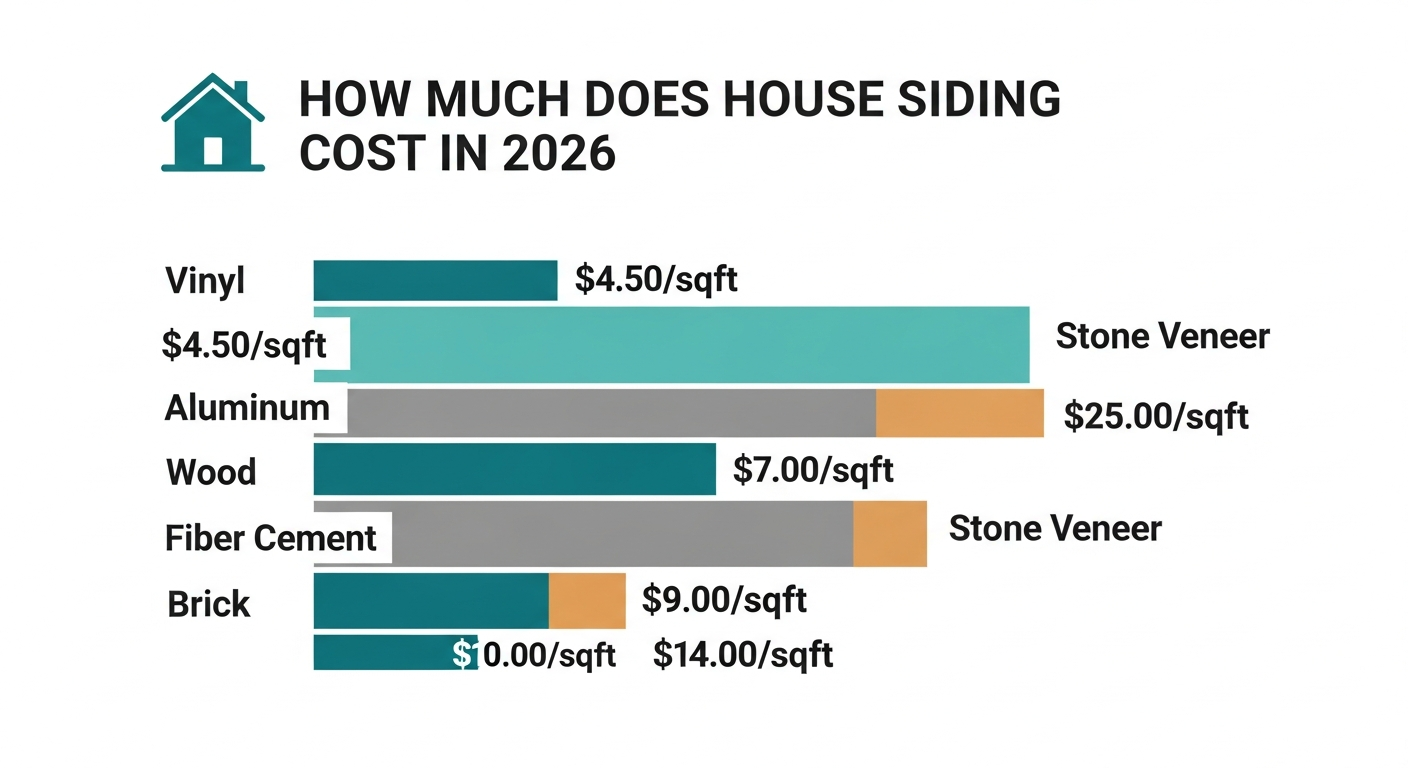
The siding material you choose determines the majority of your project cost. Here's how every major exterior siding option compares on a per-square-foot basis, including both materials and professional installation labor:
| Siding Material | Cost/Sq Ft (Installed) | 2,000 Sq Ft Home | Lifespan | Maintenance |
|---|---|---|---|---|
| Vinyl (standard) | $3.50–$7.00 | $7,000–$14,000 | 20–40 yrs | Minimal |
| Aluminum | $3.50–$7.00 | $7,000–$14,000 | 30–50 yrs | Low |
| Insulated Vinyl | $5.00–$9.00 | $10,000–$18,000 | 25–40 yrs | Minimal |
| Engineered Wood (LP SmartSide) | $4.50–$9.00 | $9,000–$18,000 | 20–30 yrs | Moderate |
| Composite | $5.00–$10.00 | $10,000–$20,000 | 25–40 yrs | Low |
| Steel | $5.00–$12.00 | $10,000–$24,000 | 40–60 yrs | Low |
| Fiber Cement | $6.00–$13.00 | $12,000–$26,000 | 30–50 yrs | Moderate |
| James Hardie (HardiePlank) | $6.50–$14.00 | $13,000–$28,000 | 30–50 yrs | Moderate |
| Cedar Wood | $6.00–$14.00 | $12,000–$28,000 | 15–40 yrs | High |
| Stucco | $6.00–$9.00 | $12,000–$18,000 | 50–80 yrs | Low |
| Stone Veneer | $12.00–$25.00 | $24,000–$50,000 | 50–100 yrs | Very Low |
| Brick | $10.00–$22.00 | $20,000–$44,000 | 75–100+ yrs | Very Low |
New construction or full replacement. Includes materials, installation labor, and basic trim. Does not include old siding removal. Source: NAHB, BLS OEWS, manufacturer data.
The most popular choice by far is vinyl — polyvinyl chloride panels that cover roughly 27% of new homes in the United States. Fiber cement (led by James Hardie) is the fastest-growing category, especially in markets where fire resistance, durability, and aesthetics command a premium. At the top end, stone veneer and brick deliver near-permanent exterior cladding but at 3–5x the price of vinyl.
Home Siding Cost by House Size
Your home's size determines the total siding area — and therefore the total project cost. Here's how house siding cost scales across common home sizes, using the three most popular materials:
| Home Size | Siding Area | Vinyl | Fiber Cement | James Hardie |
|---|---|---|---|---|
| 1,000 sq ft (ranch-style house) | ~1,000 sq ft | $3,500–$7,000 | $6,000–$13,000 | $6,500–$14,000 |
| 1,500 sq ft | ~1,500 sq ft | $5,250–$10,500 | $9,000–$19,500 | $9,750–$21,000 |
| 2,000 sq ft (average) | ~2,000 sq ft | $7,000–$14,000 | $12,000–$26,000 | $13,000–$28,000 |
| 2,500 sq ft | ~2,450 sq ft | $8,575–$17,150 | $14,700–$31,850 | $15,925–$34,300 |
| 3,000 sq ft | ~2,950 sq ft | $10,325–$20,650 | $17,700–$38,350 | $19,175–$41,300 |
New installation without old siding removal. National average labor rates. Add $1,000–$8,000+ for removal if replacing existing siding.
Keep in mind that siding area is not the same as floor area. A 2,000-square-foot single-story ranch has more exterior wall surface area per floor square foot than a 2,000-square-foot two-story home, because the two-story has a smaller footprint with taller walls. Our siding cost calculator accounts for this automatically based on your story count.
Cost of Siding Materials vs. Labor
Understanding the materials-versus-labor split helps you evaluate contractor quotes and spot where pricing might be inflated. Across all siding types, labor typically accounts for 40–55% of the total installed cost — with heavier materials like fiber cement and stone on the high end.
| Material | Material Only $/Sq Ft | Labor $/Sq Ft | Labor % of Total |
|---|---|---|---|
| Vinyl | $1.50–$3.50 | $1.50–$2.75 | ~45% |
| Engineered Wood | $2.00–$4.50 | $2.00–$3.50 | ~45% |
| Fiber Cement | $2.50–$6.50 | $3.00–$6.00 | ~50% |
| Cedar Wood | $3.00–$7.00 | $2.50–$5.00 | ~45% |
| Steel / Metal | $2.50–$6.00 | $2.50–$5.00 | ~48% |
| Stone Veneer | $6.00–$14.00 | $6.00–$11.00 | ~50% |
The average labor cost for siding installation runs $2.00 to $6.00 per square foot depending on the material and your location. BLS wage data shows the national median hourly rate for siding installers at $24–$28/hour (employee rate), but the effective rate homeowners pay — including contractor overhead, insurance, and profit — is $40 to $75/hour. States like Massachusetts (+32%), California (+30%), and New York (+25%) run well above the national average, while Mississippi (−28%) and Arkansas (−25%) run significantly below.
Factors That Influence House Siding Cost
Material Choice
As the table above shows, the material you select creates the widest price swing. Vinyl siding and aluminum are the budget options. Fiber cement, engineered wood, and metal occupy the mid-range. Cedar, stone veneer, and brick are the premium tier. Your choice should balance upfront budget against lifespan, maintenance requirements, and the aesthetic you want for your home's exterior.
Home Size and Shape
More wall surface area means more material and labor. But home shape matters just as much as size — a simple rectangular ranch-style house with minimal corners costs less per square foot to side than a home with multiple gable ends, dormers, bump-outs, and bay windows. Each of those architectural details requires custom cutting, additional trim, and slower installation. Contractors typically apply a complexity multiplier: 1.0x for simple homes, 1.15x for moderate, 1.30x for complex.
Number of Stories and Height
Single-story homes are the cheapest to side because installers work from ground level or short ladders. Two-story homes require scaffolding, which adds $300–$800 to the project and slows the pace by 10–15%. Three-story homes push that premium to 15–20%. The taller the wall, the more time and safety equipment each section requires.
Geographic Location
Labor rates are the biggest geographic variable. Using BLS regional wage data, siding installation in the Northeast and West Coast costs 20–32% more than the national average, while the Southeast and Midwest tend to run 10–25% below. Material prices also vary regionally — cedar siding is cheaper in the Pacific Northwest where it's harvested, while stucco installation is most affordable in the Southwest where plasterers are abundant.
New Construction vs. Replacement
The cost tables in this guide assume new siding installation on a prepared surface. If you're replacing existing siding, add removal and disposal costs: $0.50–$1.25/sq ft for vinyl or aluminum, $1.00–$3.00/sq ft for wood, fiber cement, or stucco. See our dedicated siding replacement cost guide for detailed tear-off pricing including asbestos abatement.
Insulation and Weather Barrier
New siding installation typically includes house wrap (Tyvek or equivalent) at $0.15–$0.30 per square foot. If you're upgrading building insulation at the same time — a smart move when the walls are exposed — rigid foam board adds $0.75–$1.50/sq ft, and spray foam insulation in wall cavities costs $1.50–$3.50/sq ft. These upgrades improve thermal insulation and energy conservation, often paying for themselves through lower heating and cooling bills within 5–10 years.
Home Siding Cost Calculator: How Ours Works
The calculator at the top of this page estimates installed siding cost using a multi-factor algorithm. BLS Occupational Employment and Wage Statistics for siding installers (OCC 47-2211) set the labor baseline. State-level multipliers adjust for regional wage differences across all 50 states plus DC. Material pricing comes from NAHB construction cost surveys and manufacturer-published data. Complexity, story count, and removal variables are applied independently.
Typical accuracy: estimates land within 10–20% of actual contractor quotes. They're designed for budget planning — not as a substitute for written estimates from licensed, insured contractors.
Full Siding Cost Estimate Breakdown
Here's a realistic example for new siding on a two-story, 2,000-square-foot home in Illinois with moderate complexity, using mid-grade vinyl siding:
| Line Item | Cost |
|---|---|
| Vinyl siding panels — mid-grade (2,200 sq ft incl. waste × $2.15/sq ft) | $4,730 |
| Trim, J-channel, corners, starter strips, soffit | $1,600 |
| House wrap (Tyvek) | $550 |
| Installation labor (2,000 sq ft × $2.45/sq ft, IL rate) | $4,900 |
| Scaffolding (2-story) | $400 |
| Permits | $350 |
| Total Project Cost | $12,530 |
| Cost per square foot (installed) | $6.27/sq ft |
Example based on 2026 pricing in suburban Chicago. New installation, no old siding removal. Actual costs will vary.
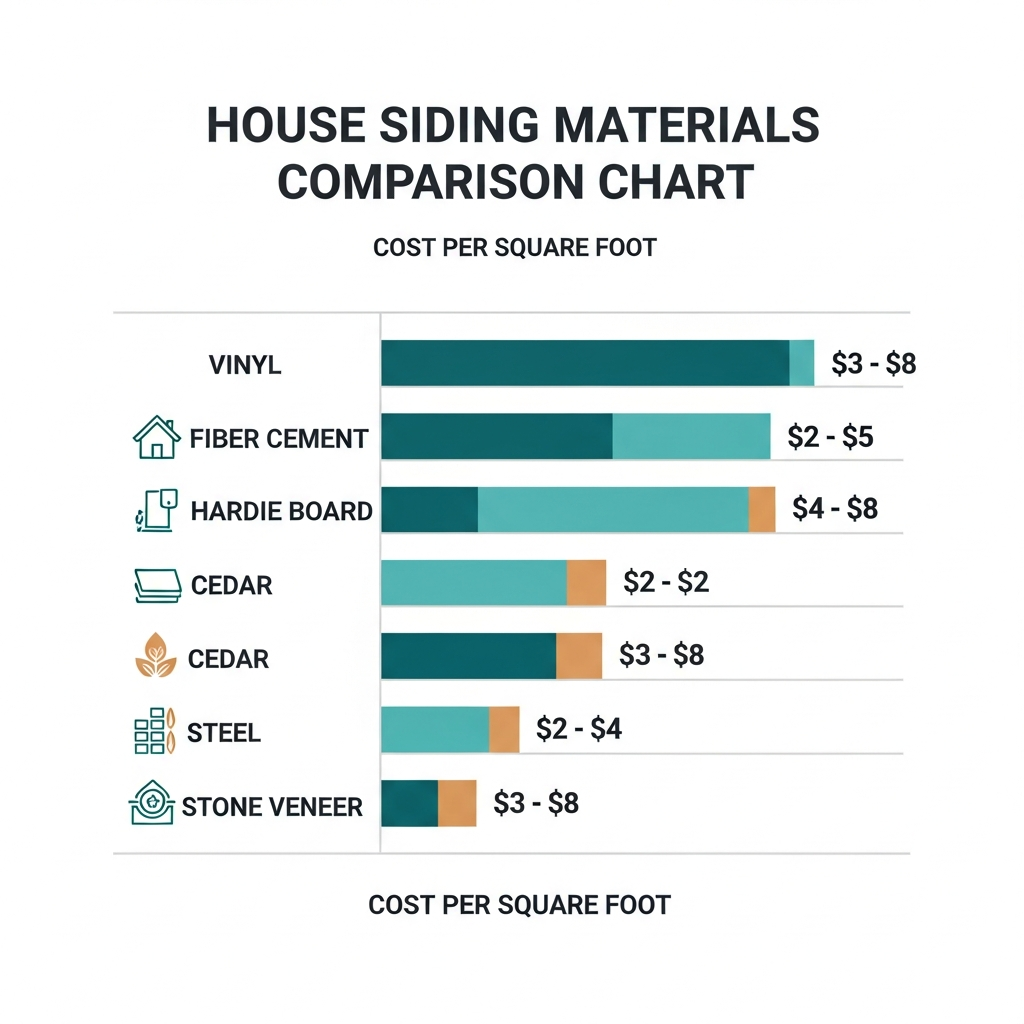
Siding Replacement Cost vs. Repair
Not every exterior project requires a full re-side. If the damage is limited to a section of wall — storm damage, impact damage, or localized rot — a siding repair may be the smarter financial move. Repairs typically cost $200 to $2,000 depending on the scope, while full replacement runs $7,000 to $50,000+.
The crossover point: if damage affects more than 25–30% of your total siding area, or if the siding is past its expected lifespan and showing widespread deterioration, full replacement almost always makes more sense financially. You get a fresh warranty, consistent appearance, and the opportunity to inspect and repair the wall sheathing underneath.
How to Save on Siding Installation Costs
Get at least three quotes. Pricing varies 20–40% between contractors for identical scope. Make sure each quote specifies the same material, grade, brand, and scope of prep work.
Schedule off-season. Late fall and winter installations (November through February) can save 10–15% on labor when contractor demand drops. Vinyl and metal siding install fine in cool weather above 40°F.
Choose standard colors. Stock colors from major manufacturers are 10–15% cheaper than custom or dark colors, which require premium pigments and UV stabilizers.
Keep good trim. If your existing soffit, fascia, and trim are structurally sound, keeping them saves $1,500–$3,000 on average.
Bundle exterior work. Combining siding with new rain gutters, window trim, or soffit replacement saves on scaffolding rental and mobilization costs.
Explore financing. Many siding contractors offer financing options — 0% APR for 12–18 months is common on projects over $10,000. Home equity lines of credit (HELOCs) and home improvement loans are also worth exploring, as the interest may be tax-deductible.
Is New House Siding a Good Investment?
New siding is one of the highest-ROI home improvement projects you can undertake. According to Remodeling Magazine's Cost vs. Value report, vinyl siding replacement recoups 67–69% of project cost at resale, and fiber cement siding recoups 70–77%. But the return on investment goes beyond the resale math — new siding eliminates moisture infiltration, improves energy efficiency through better thermal insulation and building insulation, and can reduce home insurance premiums (some carriers discount for non-combustible siding like fiber cement).
The curb appeal factor is equally important. Real estate agents consistently report that homes with new or well-maintained siding sell faster and receive stronger offers. If you're planning to sell within 3–5 years, new siding is one of the most effective ways to maximize your sale price.
What's the Most Cost-Effective Siding?
It depends on your time horizon. On a per-year-of-service basis, the rankings shift:
| Material | Upfront (2,000 sq ft) | Lifespan | Cost Per Year | Maintenance $/Yr |
|---|---|---|---|---|
| Vinyl | $10,500 | 30 yrs | $350 | ~$100 |
| Aluminum | $10,500 | 40 yrs | $263 | ~$100 |
| Steel | $17,000 | 50 yrs | $340 | ~$60 |
| Fiber Cement | $19,000 | 40 yrs | $475 | ~$200 |
| Stucco | $15,000 | 65 yrs | $231 | ~$160 |
| Cedar | $20,000 | 27 yrs | $741 | ~$700 |
| Stone Veneer | $37,000 | 75 yrs | $493 | ~$40 |
Midpoint estimates for a 2,000 sq ft home. Cost per year = upfront ÷ midpoint lifespan. Maintenance cost includes cleaning, painting, and minor repairs averaged annually.
Stucco and aluminum emerge as the best long-term value when you factor in lifespan and low maintenance. Vinyl remains the best option for budget-conscious projects and shorter ownership horizons. Cedar is the most expensive per year once you account for the 3-to-5-year staining cycle. The right choice depends entirely on how long you plan to stay in the home and how much ongoing maintenance you're willing to do.
Frequently Asked Questions About House Siding Cost
How much does it cost to side a 1,500-square-foot house?
For a 1,500-square-foot home, siding costs $5,250–$10,500 for vinyl, $9,000–$19,500 for fiber cement, and $9,750–$21,000 for James Hardie. These are installed prices without old siding removal. Use our calculator above for a state-specific estimate.
How much does 2,000 square feet of siding cost?
At national average rates, 2,000 square feet of siding costs $7,000–$14,000 for vinyl, $12,000–$26,000 for fiber cement, $13,000–$28,000 for James Hardie, and $24,000–$50,000 for stone veneer. The exact price depends on material, grade, your state, and project complexity.
How much is 1,000 square feet of siding?
For 1,000 square feet of siding, expect $3,500–$7,000 for vinyl, $6,000–$13,000 for fiber cement, and $12,000–$25,000 for stone veneer — all fully installed with labor.
Which siding is the cheapest?
Standard vinyl siding and aluminum siding are the cheapest options at $3.50–$7.00 per square foot installed. Engineered wood (LP SmartSide) at $4.50–$9.00/sq ft is the next most affordable. Vinyl is the most popular choice, covering about 27% of new homes in the United States.
What is the most expensive siding?
Natural stone and brick are the most expensive siding options at $10.00–$25.00 per square foot installed. Stone veneer is slightly more affordable than full masonry but still runs $12.00–$25.00/sq ft. These materials offer the longest lifespan (50–100+ years) and lowest maintenance.
Does new siding increase home value?
Yes. New siding recoups 67–77% of project cost at resale depending on material, according to Remodeling Magazine's Cost vs. Value report. It also improves curb appeal, energy efficiency, and can reduce home insurance premiums.
How long does siding last?
Lifespan varies by material: vinyl lasts 20–40 years, aluminum 30–50, fiber cement 30–50, cedar 15–40 (with maintenance), steel 40–60, stucco 50–80, and stone veneer 50–100+ years. Climate, sun exposure, and maintenance quality affect actual longevity.
Can I install siding myself?
Vinyl siding is the most DIY-friendly option, potentially saving $1.50–$2.75/sq ft in labor costs. However, improper installation can void warranties and cause moisture damage. Fiber cement, wood, and stone veneer require professional installation due to weight, specialized tools, and structural requirements.
When is the best time to install siding?
Late spring through early fall offers the best conditions. For cost savings, scheduling in the off-season (November through February) can save 10–15% on labor when contractor demand drops. Most siding materials install fine above 40°F.
How much does it cost to side a house per square foot?
House siding costs $3.50–$25.00 per square foot installed depending on material. Vinyl runs $3.50–$7.00, fiber cement $6.00–$13.00, James Hardie $6.50–$14.00, cedar $6.00–$14.00, and stone veneer $12.00–$25.00 per square foot.
Ready to Estimate Your House Siding Project?
Use our free calculator above to compare all siding materials with state-specific pricing. Get an instant estimate for your home size, location, and preferred material.
Related Siding Guides & Calculators
Vinyl Siding Cost
Most popular — $3.50–$7.00/sq ft
Hardie Board Cost
Premium fiber cement — $6.50–$14.00/sq ft
Siding Replacement Cost
Including removal and disposal
Siding Repair Cost
Repair vs. replace analysis
Siding Cost Calculator
Compare all materials side by side
Installation Cost
Labor and installation breakdown
Data Sources & Methodology
📊Bureau of Labor Statistics (BLS) — Occupational Employment and Wage Statistics (OEWS), OCC 47-2211 & 47-2031
🏠National Association of Home Builders (NAHB) — Construction Cost Survey, 2024-2026 data
🏭James Hardie Corp — Published product pricing and warranty specifications
🌲Western Red Cedar Bureau — Cedar siding grade pricing and specifications
🔧Active contractor pricing surveys — 50-state coverage, updated quarterly
All cost data is updated quarterly. Last comprehensive update: Q1 2026.
Home Exterior Cost Analyst
Sarah Brennan
Sarah Brennan is a construction cost researcher specializing in exterior building envelope systems. With 14 years of experience in residential construction estimating, she transitioned from managing siding installation crews to independent cost research. Her data draws from the Bureau of Labor Statistics, NAHB construction cost reports, manufacturer pricing databases, and active contractor surveys across all 50 states. Sarah is a Certified Construction Specifier (CCS) through the Construction Specifications Institute.
Important Disclaimer
The cost estimates provided by SidingCosts.com are for informational and educational purposes only. Actual siding costs vary based on local labor rates, material availability, site conditions, contractor pricing, and other factors not captured by this calculator. These estimates should not be used as a substitute for professional contractor quotes. SidingCosts.com is not a licensed contractor and does not provide installation services. Always obtain at least 3 written quotes from licensed, insured contractors in your area before starting any siding project. Data sources include the Bureau of Labor Statistics (BLS), National Association of Home Builders (NAHB), and manufacturer published pricing. Last updated: 2026.