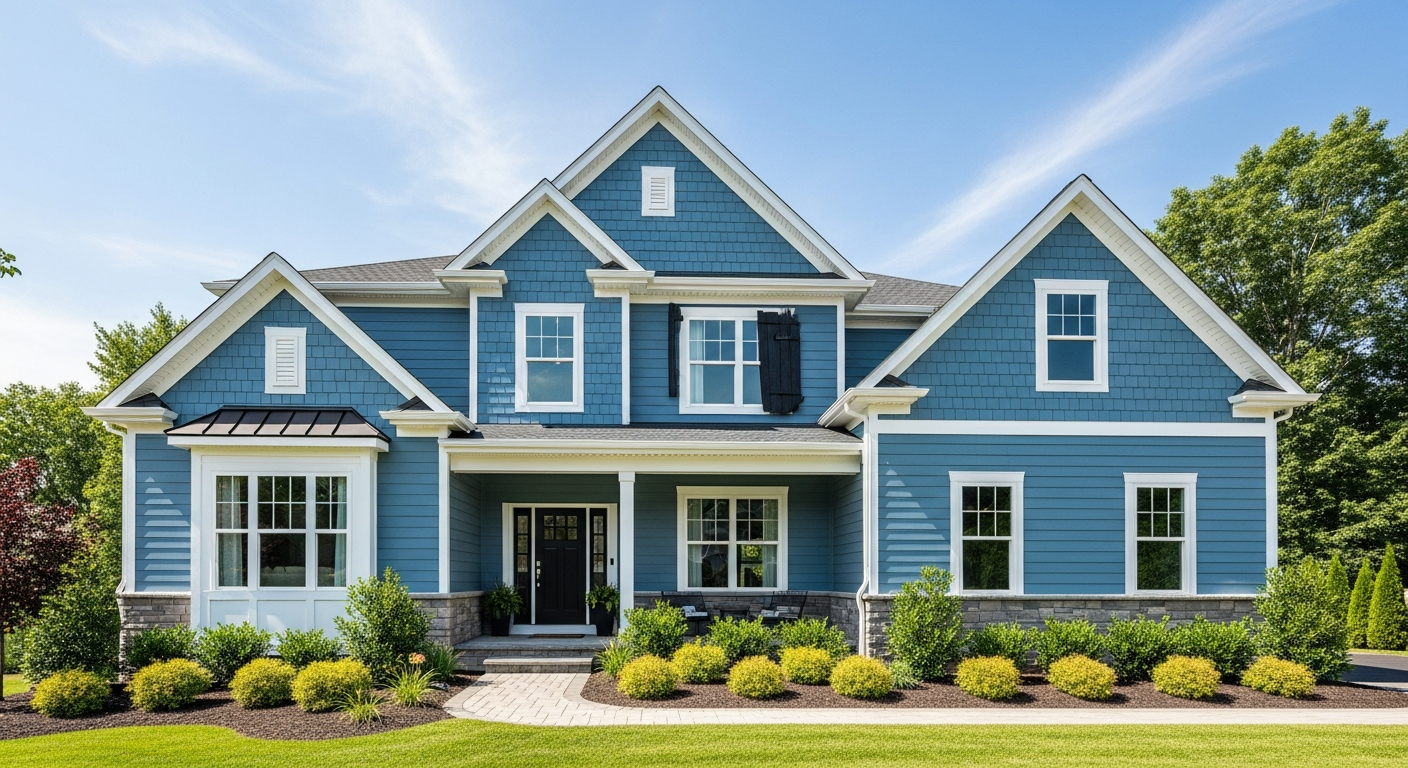
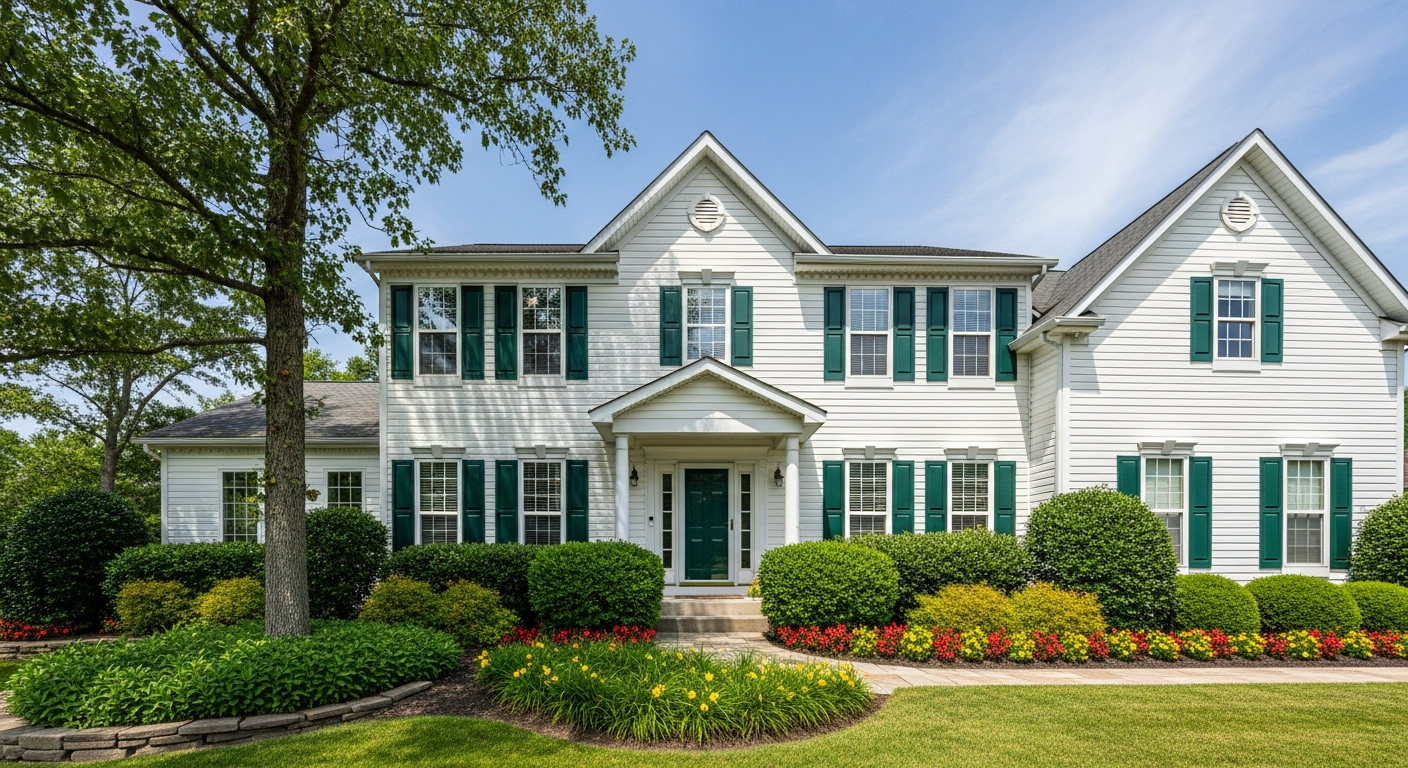
Drag the slider to compare Vinyl vs Fiber Cement siding appearance
Fiber Cement Siding vs Vinyl Siding: Side-by-Side Comparison
| Factor | Vinyl Siding | Fiber Cement Siding |
|---|---|---|
| Material | Polyvinyl chloride (PVC) plastic | Portland cement, cellulose fiber, sand |
| Cost/sqft installed | $3.50–$7.00 | $6.00–$13.00 |
| 2,000 sqft home | $7,000–$14,000 | $12,000–$26,000 |
| Lifespan | 20–40 years | 30–50 years |
| Warranty | Lifetime (limited, prorated) | 30-year non-prorated (Hardie) |
| Fire resistance | Melts / deforms | Class A (non-combustible) |
| Moisture resistance | Waterproof surface, traps moisture behind | Absorbs moisture if paint seal fails |
| Termite resistance | Immune (plastic) | Immune (cement-based) |
| R-value | R-0.61 / R-2–5 (insulated) | ~R-0.50 |
| Weight | ~0.5 lbs/sqft | ~2.5 lbs/sqft |
| Maintenance | Virtually none | Repaint every 10–15 years |
| Appearance | Uniform — synthetic profiles | Realistic wood grain — painted any color |
| Curb appeal | Good — modern options available | Excellent — mimics real wood |
| ROI at resale | Standard — expected | 70–80% cost recovery |
| Environmental | PVC — not easily recyclable | Cement-based — not biodegradable |
| Best for | Budget, low maintenance, temperate | Longevity, fire zones, premium curb appeal |
Source: James Hardie, NAHB, Remodeling Magazine Cost vs. Value Report, manufacturer data.
Cost Comparison: What You'll Actually Spend
Fiber cement costs 50–80% more than vinyl upfront. For a 2,000-square-foot home, vinyl siding runs $7,000–$14,000 installed while fiber cement runs $12,000–$26,000. That's a $5,000–$12,000 difference at installation — real money that changes the calculus for many homeowners.
| Home Size | Vinyl Siding | Fiber Cement | Difference |
|---|---|---|---|
| 1,000 sqft | $3,500–$7,000 | $6,000–$13,000 | +$2,500–$6,000 |
| 1,500 sqft | $5,250–$10,500 | $9,000–$19,500 | +$3,750–$9,000 |
| 2,000 sqft | $7,000–$14,000 | $12,000–$26,000 | +$5,000–$12,000 |
| 2,500 sqft | $8,750–$17,500 | $15,000–$32,500 | +$6,250–$15,000 |
| 3,000 sqft | $10,500–$21,000 | $18,000–$39,000 | +$7,500–$18,000 |
Installed pricing including materials, labor, and trim. Use our siding cost calculator for state-specific pricing.
Why does fiber cement cost so much more to install? Three reasons. First, the material itself costs $2.50–$6.50/sqft vs $1.50–$3.50 for vinyl — the cement, cellulose fiber, and sand mixture is simply more expensive to manufacture than extruded PVC plastic. Second, fiber cement weighs roughly 2.5 pounds per square foot — five times heavier than vinyl — requiring two-person crews and sometimes structural reinforcement on older homes. Third, cutting fiber cement produces silica dust, demanding specialized saws with dust collection and respiratory protection for installers. These labor factors push installation costs $1.00–$2.00/sqft higher than vinyl.
The cost gap narrows on a per-year basis. Vinyl at $10,000 lasting 30 years costs $333/year. Fiber cement at $20,000 lasting 45 years costs $444/year — only $111 more annually for a significant upgrade in performance, fire safety, and resale value.
Durability: Which Siding Holds Up Better?
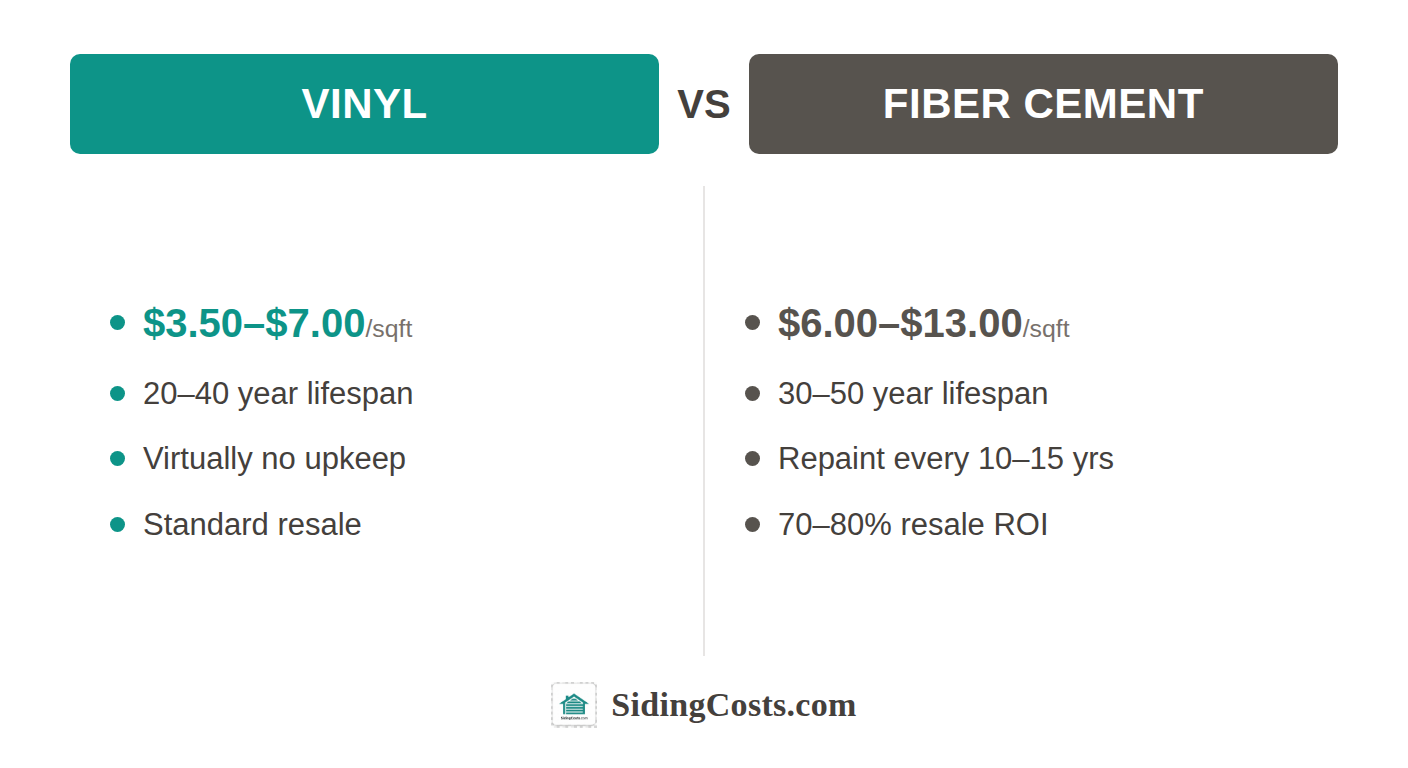
Vinyl vs fiber cement siding: key cost and performance metrics compared. Source: James Hardie, NAHB, Remodeling Magazine.
Fiber cement wins the durability comparison on nearly every metric. It's dimensionally stable — it won't warp, buckle, or sag from heat exposure the way vinyl can on south-facing walls in hot climates. It resists impact damage better than vinyl (which can crack or shatter in cold weather). It's immune to mold growth, termite damage, and UV degradation. And it maintains its appearance longer — the factory-applied or painted finish doesn't fade as quickly as vinyl's through-body pigmentation.
Vinyl's durability advantage is moisture performance. The PVC surface is completely waterproof — water runs right off. Fiber cement is porous and relies on its paint seal to keep moisture out. If the paint fails (deferred maintenance, installation damage, or ice dams), moisture penetrates the cement matrix and can cause cracking in freeze-thaw climates. This is why James Hardie developed HardieZone formulations specifically for high-moisture and freeze-thaw regions — and why proper installation with house wrap and flashing is critical for fiber cement longevity.
Fire Resistance: A Critical Difference
This is where fiber cement separates itself most decisively. Fiber cement carries a Class A fire rating — the highest available for exterior cladding. The cement-based material is non-combustible: it will not ignite, spread flame, or produce toxic smoke. Vinyl siding melts and deforms when exposed to flame or radiant heat, potentially allowing fire to reach the wall sheathing and structural framing underneath.
In wildfire-prone regions of California, Colorado, Oregon, and the Pacific Northwest, building codes increasingly require non-combustible exterior cladding for new construction and major renovations. Fiber cement meets these requirements. Vinyl does not. Some home insurers also offer premium discounts for non-combustible siding — potentially $200–$500/year off your policy in high-risk fire zones. Over 30 years, that insurance savings alone can offset a meaningful portion of fiber cement's upfront premium.
Siding Lifespan: What to Expect Long-Term
Fiber cement siding can last 30–50 years. James Hardie offers a 30-year non-prorated substrate warranty — meaning they cover the full replacement cost, not a depreciated fraction. Vinyl siding lasts 20–40 years. Most vinyl warranties are "lifetime" but heavily prorated after 10–15 years, meaning the manufacturer covers a declining percentage of material cost over time.
The practical implication: a homeowner who installs fiber cement at age 35 may never need to re-side the house again. A homeowner who installs vinyl at the same age will likely face a second siding project before retirement. That second project — including removal, disposal, and reinstallation — adds $8,000–$15,000 to the true lifetime cost of vinyl and eliminates most of the upfront savings.
Maintenance: Vinyl vs Fiber Cement Long-Term
Vinyl siding's maintenance advantage is real and significant. It never needs painting — the color runs through the entire thickness of the PVC material, so scratches don't show and fading is gradual rather than sudden. Occasional washing with a hose or pressure washer is all that's required.
Fiber cement requires repainting every 10–15 years to maintain its appearance and protective seal. That's $3,000–$6,000 per cycle for a 2,000 sqft home, or $6,000–$18,000 over a 30-year ownership period. James Hardie's ColorPlus factory finish extends the repaint interval and carries a 15-year color warranty — but repainting is still eventually necessary.
For homeowners who view exterior maintenance as a burden, vinyl is the clear choice. For those who don't mind repainting every decade and want maximum durability and curb appeal, fiber cement's maintenance needs are manageable and predictable.
Choosing the Right Siding for Your Home
Choose vinyl siding if budget is the top priority, you want zero maintenance, you're in a temperate climate without severe fire or hail risk, or you plan to sell within 10–15 years. Vinyl is also the practical choice for rental properties and investment homes where minimizing cost and maintenance maximizes returns. Insulated vinyl siding ($5.00–$9.00/sqft) adds energy efficiency without jumping to fiber cement pricing.
Choose fiber cement siding if you're staying long-term and want the last siding you'll ever install. It's the right siding for fire-prone areas where building codes or insurance rates favor non-combustible cladding, humid climates where mold and moisture resistance matter, and homes where premium curb appeal and resale value justify the higher upfront investment. If budget allows, ColorPlus factory finish reduces long-term maintenance costs.
If neither option fits perfectly, consider LP SmartSide engineered wood ($4.50–$9.00/sqft) as a middle ground — it offers real wood grain texture at a price between vinyl and fiber cement, with less weight and easier installation than fiber cement. Or explore Hardie board vs cedar if you're deciding between fiber cement and natural wood.
Frequently Asked Questions
Is fiber cement siding better than vinyl?+
What does fiber cement siding cost vs vinyl per square foot?+
Which lasts longer: fiber cement or vinyl siding?+
Does fiber cement siding lower home insurance?+
What are the drawbacks of fiber cement siding?+
Is insulated vinyl siding worth it vs fiber cement?+
Does siding replacement improve resale value?+
How does climate affect the choice between vinyl and fiber cement?+
Compare Costs for Your Home
Get state-specific estimates for vinyl and fiber cement siding.
Related Siding Comparisons
Vinyl vs Hardie Board
Budget vs premium fiber cement
Hardie Board vs Cedar
Premium vs premium
LP SmartSide Cost
Mid-range alternative
Compare All Materials
Side-by-side calculator
Data Sources & Methodology
📊Bureau of Labor Statistics (BLS) — Occupational Employment and Wage Statistics (OEWS), OCC 47-2211 & 47-2031
🏠National Association of Home Builders (NAHB) — Construction Cost Survey, 2024-2026 data
🏭James Hardie Corp — Published product pricing and warranty specifications
🌲Western Red Cedar Bureau — Cedar siding grade pricing and specifications
🔧Active contractor pricing surveys — 50-state coverage, updated quarterly
All cost data is updated quarterly. Last comprehensive update: Q1 2026.
Home Exterior Cost Analyst
Sarah Brennan
Sarah Brennan is a construction cost researcher specializing in exterior building envelope systems. With 14 years of experience in residential construction estimating, she transitioned from managing siding installation crews to independent cost research. Her data draws from the Bureau of Labor Statistics, NAHB construction cost reports, manufacturer pricing databases, and active contractor surveys across all 50 states. Sarah is a Certified Construction Specifier (CCS) through the Construction Specifications Institute.
Important Disclaimer
The cost estimates provided by SidingCosts.com are for informational and educational purposes only. Actual siding costs vary based on local labor rates, material availability, site conditions, contractor pricing, and other factors not captured by this calculator. These estimates should not be used as a substitute for professional contractor quotes. SidingCosts.com is not a licensed contractor and does not provide installation services. Always obtain at least 3 written quotes from licensed, insured contractors in your area before starting any siding project. Data sources include the Bureau of Labor Statistics (BLS), National Association of Home Builders (NAHB), and manufacturer published pricing. Last updated: 2026.