What Is Hardie Board Siding?
Hardie board — also called HardiePlank — is a fiber cement siding product manufactured by James Hardie Industries, the world's largest fiber cement company. The material is made from a mixture of cement, cellulose fiber, sand, and water, pressed and cured into planks that mimic the look of natural wood grain without the maintenance problems. James Hardie controls roughly 90% of the North American fiber cement siding market, which is why “Hardie board” and “fiber cement siding” are often used interchangeably — though other brands like Nichiha and Allura also make fiber cement products.
What sets James Hardie apart from generic fiber cement is their climate-zone engineering. HardiePlank comes in two formulations: HZ5 for moderate climates and HZ10 for regions with frequent freeze-thaw cycles. This engineered approach to moisture resistance is something competitors haven't matched, and it's a major reason contractors in the United States tend to specify Hardie by name.
Average Cost of James Hardie Siding
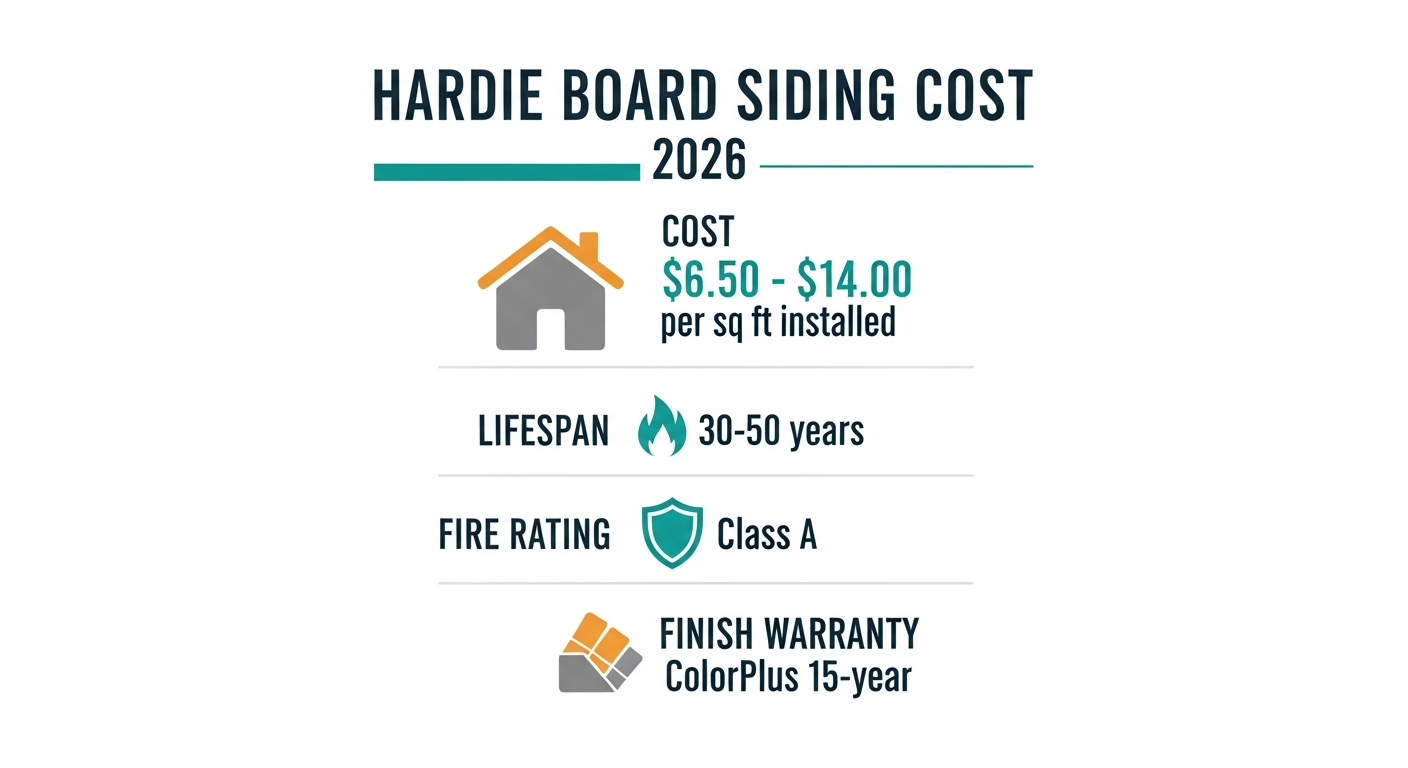
The average Hardie board siding cost runs $6.50 to $14.00 per square foot fully installed. Material alone — just the HardiePlank panels — costs $3.00 to $7.00 per square foot depending on the product line and finish. The rest is labor, which accounts for roughly 50% of the total installed price. That labor share is higher than vinyl siding (45%) because fiber cement is heavier, requires specialized cutting tools, and demands more careful handling during installation.
| Home Size | Siding Area (approx.) | Low Estimate | High Estimate | Midpoint |
|---|---|---|---|---|
| 1,000 sq ft (small ranch) | ~1,000 sq ft | $6,500 | $14,000 | $10,250 |
| 1,500 sq ft | ~1,500 sq ft | $9,750 | $21,000 | $15,375 |
| 2,000 sq ft (average home) | ~2,000 sq ft | $13,000 | $28,000 | $20,500 |
| 2,500 sq ft | ~2,450 sq ft | $15,925 | $34,300 | $25,113 |
| 3,000 sq ft (large home) | ~2,950 sq ft | $19,175 | $41,300 | $30,238 |
Source: James Hardie Corp published pricing, NAHB construction cost data, BLS OEWS. Includes materials, labor, and basic trim. Does not include old siding removal.
One thing that catches homeowners off guard: that $6.50 floor is realistic only for primed HardiePlank lap siding on a simple one-story home in a low-cost-of-labor state. Most projects with ColorPlus factory-finished panels on a two-story home land in the $9.00 to $12.00 per square foot range — which is where the majority of Hardie board installations actually fall.
James Hardie Siding Cost Per Square Foot: Materials vs. Labor
The cost breakdown for James Hardie siding looks different from vinyl because labor takes a bigger share. Here's how the per-square-foot pricing splits:
| Cost Component | Per Sq Ft (Low) | Per Sq Ft (High) | % of Total |
|---|---|---|---|
| HardiePlank panels (material) | $2.00 | $5.00 | 28–35% |
| Trim, corners, soffits (HardieTrim) | $0.75 | $1.50 | 10–12% |
| House wrap / flashing | $0.25 | $0.50 | 3–5% |
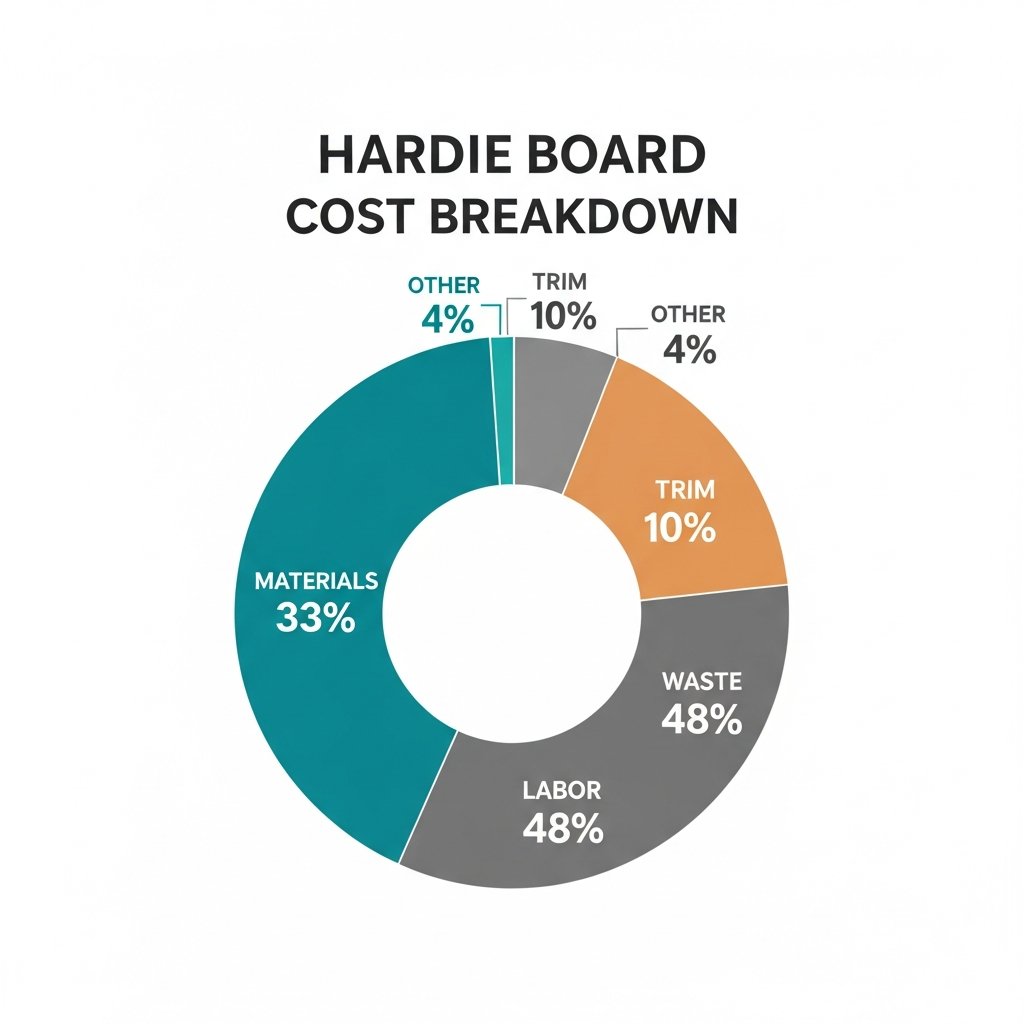
| Installation labor | $3.00 | $6.00 | 45–50% |
| Waste / overage (10%) | $0.30 | $0.70 | 4–5% |
| Caulking, paint touch-up, fasteners | $0.20 | $0.30 | 2–3% |
| Total installed | $6.50 | $14.00 | 100% |
Labor is more expensive for Hardie board than for most other siding materials. The planks weigh approximately 2.5 pounds per square foot — about 5x heavier than vinyl panels. Each plank needs to be cut with a fiber cement shear or circular saw with a specialized HardieBlade, and the cutting process generates silica dust that requires respiratory protection. All of this means slower installation, more crew members, and higher per-hour costs. A typical crew installs 200 to 350 square feet of Hardie board per day, compared to 300 to 500 for vinyl.
James Hardie Product Line: Pricing by Product
James Hardie doesn't just make one product. Their lineup spans several profiles and price points, and the product you choose has a significant impact on the total project cost:
| Product | Material $/Sq Ft | Installed $/Sq Ft | Profile |
|---|---|---|---|
| HardiePlank Lap (Primed) | $2.00–$3.50 | $6.50–$10.00 | Horizontal lap, most common |
| HardiePlank Lap (ColorPlus) | $3.50–$5.50 | $8.00–$13.00 | Factory-finished, 15-yr color warranty |
| HardieShingle | $4.00–$6.00 | $9.00–$14.00 | Staggered edge, cedar shake look |
| HardiePanel (Vertical) | $3.00–$5.00 | $7.50–$12.00 | Smooth/stucco, board and batten ready |
| Artisan V-Groove | $5.00–$7.00 | $10.00–$14.00 | Premium, deep shadow line |
ColorPlus vs. Primed: Which Finish Should You Choose?
This is one of the biggest pricing decisions in any Hardie board project. ColorPlus is James Hardie's factory-applied finish — multiple coats of paint baked on in a controlled environment. It costs $1.50 to $2.50 more per square foot than primed panels, but it comes with a 15-year warranty against peeling, cracking, chipping, and fading. That warranty is significantly stronger than what any field-applied paint job can match.
Primed HardiePlank ships ready for your painter to finish on-site. The material is cheaper, but you'll spend $1.50 to $3.00 per square foot on painting labor and materials — and you'll need to repaint every 10 to 15 years. Over a 30-year period, the total cost of ownership for primed-and-painted often exceeds ColorPlus by $3,000 to $6,000 for an average home.
The bottom line: ColorPlus costs more upfront but eliminates the painting cycle. For most homeowners planning to stay in their home long-term, the factory finish is the better investment.
Is Professional Installation Worth the Labor Cost?
Unlike vinyl siding, Hardie board is not a realistic do-it-yourself project for most homeowners. The weight alone makes it a two-person minimum job. But beyond that, James Hardie requires installation by trained professionals to maintain the product warranty. Improper nailing, insufficient gapping, or incorrect flashing details can void the warranty entirely — and with a product that's supposed to last 30 to 50 years, that warranty matters.
James Hardie runs a contractor certification program with three tiers: Preferred, Elite Preferred, and Contractor Alliance. Elite Preferred contractors have completed Hardie-specific training and installed a verified volume of projects. They're also the only contractors authorized to offer the full ColorPlus warranty. If you're spending $20,000+ on Hardie board, hiring a certified installer is worth the premium.
Installation labor for James Hardie siding runs $3.00 to $6.00 per square foot depending on your state, the number of stories, and the architectural complexity. That's roughly 30–50% more than vinyl siding labor, which reflects the heavier material, slower installation speed, and specialized tooling requirements.
What Drives the Cost of James Hardie Siding?
Several factors push Hardie board siding cost up or down from the national averages. Understanding these helps you read contractor quotes more intelligently.
Product Line and Finish
As shown in the pricing table above, the product you choose is the single biggest variable. Primed HardiePlank lap siding is the entry point. ColorPlus, HardieShingle, and Artisan V-Groove push progressively higher. Many homes use a mix — HardiePlank on the main walls with HardieShingle accents on gable ends — which lands the blended price somewhere in the middle.
Home Size and Geometry
More siding area means more material and labor, obviously. But the relationship isn't perfectly linear. Larger homes spread the contractor's fixed costs (mobilization, scaffold setup, permits) across more square footage, which can slightly reduce the per-square-foot price. Complex geometry — lots of windows, dormers, inside corners, and roof transitions — increases the cost because each cut and trim detail takes time with fiber cement's heavier, less forgiving planks.
Number of Stories
Scaffolding is not optional with Hardie board on two-story or taller homes. The material is too heavy to safely handle from ladders. Scaffold rental and setup adds $300 to $800 to the project, and the slower pace of working at height increases labor hours by 10–20%.
Geographic Location and Labor Rates
BLS wage data shows that siding installer wages vary 25–35% between states. Massachusetts, Connecticut, New Jersey, California, and New York are the most expensive markets. Mississippi, Arkansas, West Virginia, and Alabama are the least expensive. The calculator at the top of this page applies state-specific multipliers automatically.
Old Siding Removal
Replacing existing siding adds removal and disposal costs. Old vinyl comes off cheaply ($0.50–$1.25/sq ft), but removing old wood or stucco costs significantly more ($1.00–$3.00/sq ft). James Hardie requires a clean, flat substrate — so any damaged sheathing or wall issues must be addressed before installation. See our siding replacement cost guide for detailed removal pricing.
How Our Hardie Board Cost Calculator Works
The calculator on this page uses the same multi-factor algorithm as our other siding tools. BLS Occupational Employment and Wage Statistics for siding installers (OCC 47-2211) establish the labor baseline. State-level multipliers adjust for regional wage differences across all 50 states plus DC. James Hardie material pricing comes from published manufacturer data and NAHB construction cost surveys. Complexity, story count, and removal variables are applied independently.
Typical accuracy: estimates land within 10–20% of actual contractor quotes. They give you a solid ballpark for budget planning, but should not replace written quotes from licensed, insured contractors in your area.
Cost Breakdown: Hardie Board for a 2,000-Square-Foot Home
Here's a realistic project example. Two-story, 2,000-square-foot home in Ohio with moderate complexity, replacing old vinyl siding with ColorPlus HardiePlank lap siding.
| Line Item | Cost |
|---|---|
| Old vinyl siding removal (2,000 sq ft × $0.75/sq ft) | $1,500 |
| Disposal and hauling | $400 |
| HardiePlank ColorPlus panels (2,200 sq ft incl. waste × $4.50/sq ft) | $9,900 |
| HardieTrim, corners, starter strips | $2,200 |
| House wrap, flashing, caulking | $800 |
| Installation labor (2,000 sq ft × $4.20/sq ft, OH rate) | $8,400 |
| Scaffolding (2-story) | $500 |
| Permits | $500 |
| Total Project Cost | $24,200 |
| Cost per square foot (installed, including removal) | $12.10/sq ft |
Example based on 2026 pricing in central Ohio. ColorPlus finish. Actual costs will vary by state and project specifics.
Without old siding removal ($1,900), the same project drops to about $22,300 — or $11.15 per square foot. That's a representative midpoint for ColorPlus HardiePlank on a moderately complex two-story home.
Hardie Board vs. Vinyl Siding Cost
This is the comparison most homeowners are actually making. Vinyl is the default. Hardie board is the upgrade. Here's how they stack up on the numbers:
| Factor | Vinyl Siding | Hardie Board |
|---|---|---|
| Installed cost per sq ft | $3.50–$7.00 | $6.50–$14.00 |
| Total for 2,000 sq ft home | $7,000–$14,000 | $13,000–$28,000 |
| Material (PVC vs. fiber cement) | Polyvinyl chloride | Cement, cellulose, sand |
| Lifespan | 20–40 years | 30–50 years |
| Fire rating | Melts (not fire-rated) | Class A (non-combustible) |
| Impact resistance | Can crack in cold | Excellent |
| Pest resistance | Good (not food source) | Excellent (insect-proof) |
| Moisture resistance | Good | Excellent (HZ10 formulation) |
| Maintenance | Minimal | Repaint every 10–15 yrs (primed only) |
| Annual cost (over lifespan) | $175–$350/yr | $260–$560/yr |
| ROI at resale | 67–69% | 70–77% |
The upfront price gap is significant — Hardie board costs roughly 1.8x to 2x more than vinyl. But look at the annual cost over the full lifespan. The gap narrows considerably because Hardie board lasts 10–15 years longer on average. And the ROI at resale is consistently higher for fiber cement — real estate agents report that Hardie board is one of the few siding materials that buyers actively look for by name.
For the full breakdown, see our vinyl vs. Hardie board comparison guide.
What Are the Negatives of Hardie Board Siding?
No siding material is perfect. Here are the legitimate downsides of Hardie board that you should weigh against its durability and aesthetics:
Higher upfront cost. At $6.50–$14.00/sq ft installed, Hardie board is among the more expensive siding options. It's less than stone veneer or brick, but significantly more than vinyl or aluminum.
Weight requires structural awareness. At 2.5 lbs/sq ft, HardiePlank is heavy. Older homes with compromised wall framing may need structural evaluation before installation. The weight also means higher labor costs and slower installation speed.
Brittleness during handling. Fiber cement planks can crack or chip if dropped or handled roughly during transport and installation. Once installed, impact resistance is excellent — but the installation process demands care that vinyl doesn't require.
Painting required (primed version). If you choose primed HardiePlank over ColorPlus, you're committing to a painting cycle every 10 to 15 years. That's a significant long-term maintenance cost that cuts into the material's longevity advantage.
Silica dust during cutting. Cutting fiber cement generates crystalline silica dust, which is a serious respiratory hazard. Professional installers use HardieBlades and dust collection systems. This is a key reason DIY installation is not recommended.
Is Hardie Board Siding Worth the Investment?
Fiber cement siding — and James Hardie specifically — consistently ranks as one of the highest-ROI exterior improvements in Remodeling Magazine's annual Cost vs. Value report. Fiber cement siding replacement recoups approximately 70–77% of the project cost at resale, compared to 67–69% for vinyl.
But the real value of Hardie board goes beyond the resale math. This is a material that genuinely performs differently than vinyl or wood in ways that affect your daily life: it won't melt in a wildfire zone (Class A fire rating), it won't attract termites or carpenter ants (insect-proof composition), it won't warp in Texas heat or crack in Minnesota cold (climate-zone engineering), and it won't fade from UV exposure as fast as vinyl does.
Some home insurance companies offer premium discounts for non-combustible siding, particularly in wildfire-prone areas of California, Colorado, and the Pacific Northwest. These savings — typically $200 to $500 per year — won't pay for the siding, but they chip away at the cost premium over time.
The homeowners who get the most value from Hardie board are those planning to stay in their home for 10+ years, living in areas with weather extremes or fire risk, and prioritizing curb appeal and long-term durability over the lowest possible upfront budget.
What the Warranty Actually Covers
James Hardie offers a 30-year non-prorated limited warranty on HardiePlank siding against manufacturing defects. The ColorPlus factory finish carries a separate 15-year warranty covering peeling, cracking, chipping, and fading. Both warranties are transferable to subsequent homeowners, which adds resale value.
Important fine print: the warranty requires installation by a qualified contractor following James Hardie's published installation instructions. Improper nailing patterns, insufficient clearance from grade, or failure to use approved flashing and caulking can void the warranty. This is why hiring a Hardie-certified installer matters — and why research into your contractor's credentials is worth the time.
Frequently Asked Questions About Hardie Board Siding Cost
How much does it cost to put Hardie board on a 2,000-square-foot house?
For a 2,000-square-foot home, Hardie board siding costs $13,000 to $28,000 installed. With ColorPlus factory finish and old siding removal, most projects land in the $20,000 to $26,000 range. Use our calculator above for a state-specific estimate.
How much is Hardie board for a 1,500-square-foot house?
A 1,500-square-foot home costs $9,750 to $21,000 for Hardie board installation at national average rates. Without removal of old siding, the typical range is $9,750 to $19,500.
Is Hardie board cheaper than vinyl siding?
No. Hardie board costs roughly 1.8x to 2x more than vinyl siding upfront ($6.50–$14.00/sq ft vs. $3.50–$7.00/sq ft). However, Hardie board lasts 30–50 years vs. vinyl's 20–40, and it recoups a higher percentage at resale (70–77% vs. 67–69%).
Is Hardie plank cheaper than wood siding?
Generally yes, when you factor in lifetime cost. Cedar siding costs $6.00–$14.00/sq ft installed — similar to Hardie board upfront. But cedar requires staining every 3–5 years ($1.50–$3.00/sq ft each time), while ColorPlus HardiePlank needs no repainting for 15+ years. Over 30 years, cedar typically costs 30–50% more in total than Hardie board.
How long does Hardie board siding last?
James Hardie fiber cement siding lasts 30 to 50 years depending on climate, installation quality, and maintenance. The product carries a 30-year manufacturer warranty. The ColorPlus factory finish is warranted for 15 years against fading, peeling, and cracking.
What are the negatives of Hardie board siding?
The main drawbacks are: higher upfront cost ($6.50–$14.00/sq ft vs. $3.50–$7.00 for vinyl), heavier material requiring professional installation, brittleness during handling (can crack if dropped), silica dust during cutting (respiratory hazard), and painting required every 10–15 years if you choose primed over ColorPlus.
Does Hardie board add value to your home?
Yes. Fiber cement siding replacement recoups approximately 70–77% of the project cost at resale, making it one of the highest-ROI exterior improvements. Hardie board is one of the few siding materials that real estate agents and buyers actively seek by brand name.
How long does it take to install Hardie board siding?
A typical crew of 3–4 installers can complete a 2,000-square-foot home in 5 to 8 working days depending on complexity. That's roughly 40–60% slower than vinyl siding installation due to the heavier material and specialized cutting requirements.
Can you paint Hardie board siding?
Yes. Primed HardiePlank must be painted after installation. ColorPlus panels come pre-painted with a 15-year warranty and don't need painting for at least that period. When repainting is eventually needed, Hardie board accepts paint very well — better than vinyl, which requires special vinyl-safe paint.
Is Hardie siding more expensive than other fiber cement brands?
Slightly. James Hardie HardiePlank costs $3.00–$7.00/sq ft for materials, while competing fiber cement brands like Nichiha ($2.50–$5.50/sq ft) and Allura ($2.00–$5.00/sq ft) are 10–20% less. However, Hardie's climate-zone engineering (HZ5/HZ10), industry-leading warranty, and wider contractor support justify the premium for most projects.
Ready to Estimate Your Hardie Board Project?
Use our free calculator above to get a state-specific estimate for James Hardie siding, then compare against vinyl and other materials to find the right fit for your home and budget.
Related Siding Calculators
Vinyl vs. Hardie Board
Full cost and value comparison
Fiber Cement Siding Cost
All fiber cement brands compared
Hardie vs. Cedar Siding
Fiber cement vs. natural wood
Vinyl Siding Cost
The most affordable alternative
Siding Replacement Cost
Full replacement with removal
All Materials Calculator
Compare every siding type side by side
Data Sources & Methodology
🏭James Hardie Industries — Published product pricing, ColorPlus specifications, HZ5/HZ10 climate zone data
📊Bureau of Labor Statistics (BLS) — Occupational Employment and Wage Statistics (OEWS), OCC 47-2211 & 47-2031
🏠National Association of Home Builders (NAHB) — Construction Cost Survey, 2024-2026 data
🔧Active contractor pricing surveys — 50-state coverage, updated quarterly
📈Remodeling Magazine — Annual Cost vs. Value Report, fiber cement siding ROI data
All cost data is updated quarterly. Last comprehensive update: Q1 2026.
Home Exterior Cost Analyst
Sarah Brennan
Sarah Brennan is a construction cost researcher specializing in exterior building envelope systems. With 14 years of experience in residential construction estimating, she transitioned from managing siding installation crews to independent cost research. Her data draws from the Bureau of Labor Statistics, NAHB construction cost reports, manufacturer pricing databases, and active contractor surveys across all 50 states. Sarah is a Certified Construction Specifier (CCS) through the Construction Specifications Institute.
Important Disclaimer
The cost estimates provided by SidingCosts.com are for informational and educational purposes only. Actual siding costs vary based on local labor rates, material availability, site conditions, contractor pricing, and other factors not captured by this calculator. These estimates should not be used as a substitute for professional contractor quotes. SidingCosts.com is not a licensed contractor and does not provide installation services. Always obtain at least 3 written quotes from licensed, insured contractors in your area before starting any siding project. Data sources include the Bureau of Labor Statistics (BLS), National Association of Home Builders (NAHB), and manufacturer published pricing. Last updated: 2026.