Understanding Siding Replacement Costs
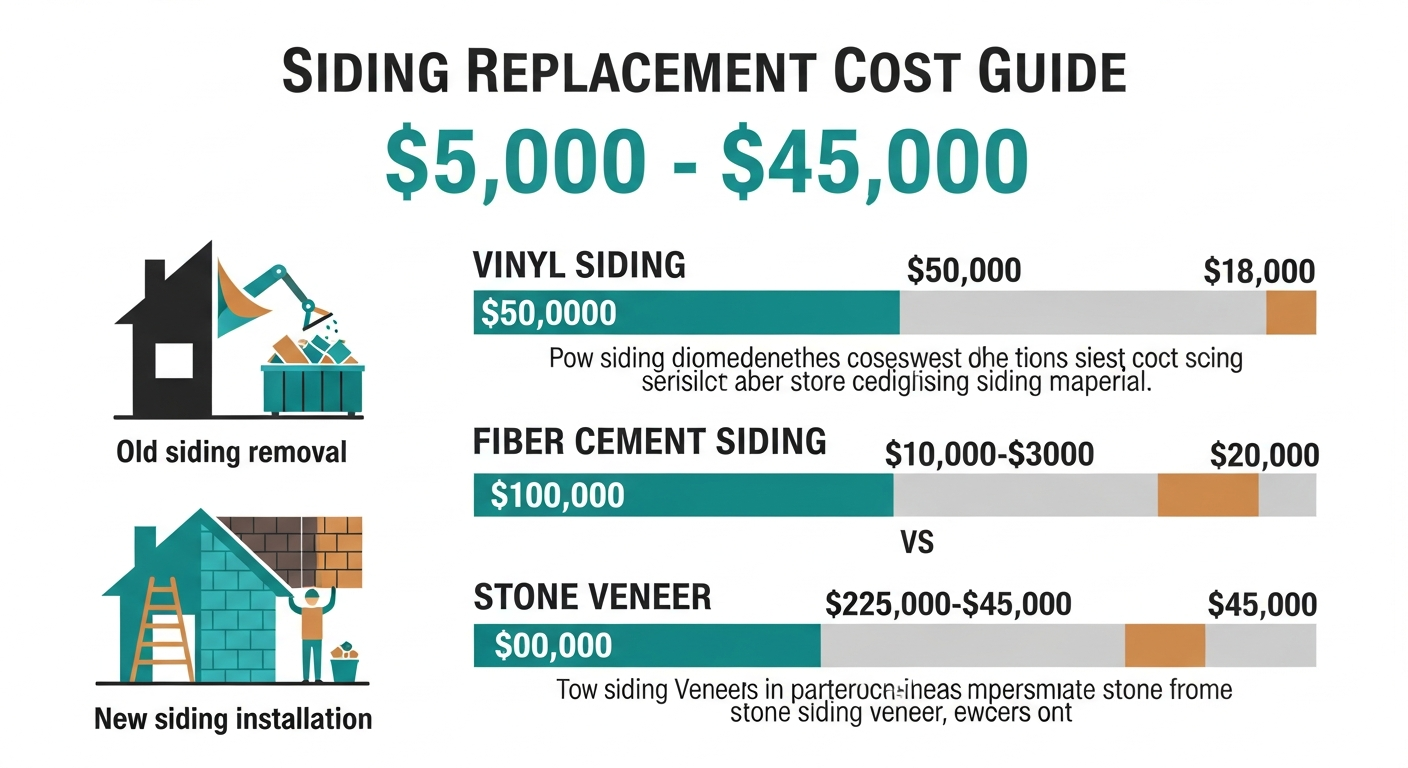
Siding replacement is a two-part project: removing the old siding and installing the new. That distinction matters because the removal phase adds $1,000 to $8,000+ to the total depending on what's currently on your walls. Many homeowners focus only on the cost of new siding and get blindsided when the full replacement estimate comes in 15–30% higher than they expected.
The total siding replacement cost depends on four main variables: the material you're removing, the material you're replacing it with, the square footage of siding area on your house, and your geographic location. Labor rates for siding installers vary 25–35% between states according to BLS wage data — and that swing alone can mean a $3,000 to $5,000 difference on a mid-size home.
Siding Replacement Cost by Material Type
The new material you choose is the single biggest driver of your total replacement budget. Here's how the major siding materials compare on a fully installed basis — including removal of old vinyl siding, new material, labor, and permits — for a 2,000-square-foot home:
| New Material | Cost/Sq Ft (Installed) | 2,000 Sq Ft Home (Total) | Lifespan |
|---|---|---|---|
| Vinyl (standard) | $3.50–$7.00 | $9,000–$17,000 | 20–40 yrs |
| Insulated Vinyl | $5.00–$9.00 | $12,000–$21,000 | 25–40 yrs |
| Engineered Wood (LP SmartSide) | $4.50–$9.00 | $11,000–$21,000 | 20–30 yrs |
| Fiber Cement | $6.00–$13.00 | $14,000–$29,000 | 30–50 yrs |
| James Hardie (HardiePlank) | $6.50–$14.00 | $15,000–$31,000 | 30–50 yrs |
| Cedar Wood | $6.00–$14.00 | $14,000–$31,000 | 15–40 yrs |
| Metal (Steel) | $5.00–$12.00 | $12,000–$27,000 | 40–60 yrs |
| Aluminum | $3.50–$7.00 | $9,000–$17,000 | 30–50 yrs |
| Stone Veneer | $12.00–$25.00 | $26,000–$53,000 | 50–100 yrs |
| Stucco | $6.00–$9.00 | $14,000–$21,000 | 50–80 yrs |
Totals include old vinyl siding removal ($0.50–$1.25/sq ft), disposal, new material, labor, and permits. Source: NAHB, BLS, manufacturer data.
A few things stand out in this table. First, vinyl-to-vinyl replacement is the most affordable path — roughly $9,000 to $17,000 for an average home. Second, upgrading to fiber cement or James Hardie nearly doubles the price but adds 10–20 years of lifespan and a higher return on investment at resale. Third, stone veneer is the premium outlier — beautiful and nearly permanent, but a $26,000+ commitment.
Siding Replacement Cost by Home Size
Home size determines how much siding area needs to be covered. Here's how replacement costs scale using mid-grade vinyl as the baseline (the most common replacement scenario in the United States):
| Home Size | Siding Area | Vinyl Replacement | Fiber Cement Replacement | Hardie Board Replacement |
|---|---|---|---|---|
| 1,000 sq ft (ranch-style house) | ~1,000 sq ft | $4,500–$8,500 | $7,000–$14,500 | $7,500–$15,500 |
| 1,500 sq ft | ~1,500 sq ft | $6,750–$12,750 | $10,500–$21,750 | $11,250–$23,250 |
| 2,000 sq ft (average) | ~2,000 sq ft | $9,000–$17,000 | $14,000–$29,000 | $15,000–$31,000 |
| 2,500 sq ft | ~2,450 sq ft | $11,025–$20,825 | $17,150–$35,525 | $18,375–$37,975 |
| 3,000 sq ft | ~2,950 sq ft | $13,275–$25,075 | $20,650–$42,775 | $22,125–$45,725 |
Includes removal of old vinyl siding, new material, installation labor, disposal, and permits. National average labor rates.
How Much Does Siding Removal Cost?
The removal phase is the cost most homeowners underestimate. What you're currently living behind matters a lot — some materials come off in minutes, others take days.
| Existing Material | Removal Cost/Sq Ft | 2,000 Sq Ft Removal | Notes |
|---|---|---|---|
| Vinyl siding | $0.50–$1.00 | $1,000–$2,000 | Fastest to remove, lightweight |
| Aluminum siding | $0.50–$1.25 | $1,000–$2,500 | Often recyclable (scrap value offsets cost) |
| Wood siding | $1.00–$2.00 | $2,000–$4,000 | Nailed to sheathing, labor-intensive |
| Fiber cement | $1.00–$2.50 | $2,000–$5,000 | Heavy, requires careful handling |
| Stucco | $1.50–$3.00 | $3,000–$6,000 | Must be chipped off, very labor-intensive |
| Brick veneer | $2.00–$4.00 | $4,000–$8,000 | Masonry veneer removal, structural considerations |
| Asbestos siding | $3.00–$8.00 | $6,000–$16,000 | Professional abatement required, hazmat disposal |
Disposal and hauling adds another $0.25 to $0.75 per square foot on top of removal labor. For a 2,000-square-foot home, that's $500 to $1,500 for dumpster rental and dump fees. Some contractors include disposal in their per-square-foot removal price; others break it out separately. Always confirm what's included in the quote.
Can You Install New Siding Over Old Siding?
Sometimes. Vinyl siding can sometimes be installed over existing vinyl or aluminum without full removal — a process called “recover” or “re-side.” This saves the removal and disposal cost ($1,500 to $3,000 on an average home), but there are trade-offs. You can't inspect or repair the wall sheathing underneath, you add weight to the wall assembly, and you may void the new siding warranty. Most siding professionals and manufacturer installation guides recommend full removal, especially if the home is more than 20 years old or shows signs of moisture damage.
Fiber cement, wood, and stucco siding should never be installed over old siding. These materials require a clean, flat, structurally sound substrate with proper house wrap and flashing.
Other Factors Affecting Siding Replacement Costs
Damaged Sheathing and Framing
This is the hidden expense that turns a $15,000 project into a $20,000+ project. When old siding comes off and the crew finds rotted plywood, water-damaged OSB, or compromised framing underneath, it must be repaired before new siding can go on. Sheathing replacement adds $2.00 to $4.00 per square foot for the affected area. On older homes — especially those with wood siding that trapped moisture — 10 to 30% of the wall sheathing may need replacement. That's a budget item you can't know for certain until the old siding is off.
Building Insulation Upgrades
Siding replacement is the ideal time to improve your home's wall insulation. With the old siding removed and sheathing exposed, adding rigid foam insulation or spray foam to the wall cavities is far cheaper than doing it as a standalone project. A 1-inch rigid foam board adds approximately $0.75 to $1.50 per square foot and improves both energy efficiency and the wall's weather resistance — a worthwhile upgrade for homes in cold climates.
House Height and Complexity
Two-story homes cost 10–15% more per square foot than single-story ranch-style houses because of scaffolding requirements and slower work at height. Complex architectural designs with many windows, dormers, gable ends, and roof transitions push costs further — each of these features requires careful trim work and custom cuts that eat labor hours.
Permits and Inspections
Many municipalities require building permits for siding replacement, even if you're using the same material. Permit costs range from $150 to $750 depending on the project value and your local building department. Some areas also require a final inspection. Your contractor should pull the permit as part of the project — if they suggest skipping it, that's a red flag.
Season and Contractor Demand
Siding replacement demand peaks from late spring through early fall. Scheduling your project in the off-season (November through February in most of the United States) can save 10–15% on labor. The trade-off is weather risk and potentially longer project timelines if cold or wet days force work stoppages.
How Our Siding Replacement Cost Calculator Works
The calculator at the top of this page estimates full replacement costs including removal, disposal, new material, labor, and permits. It uses BLS Occupational Employment and Wage Statistics for siding installer wages (OCC 47-2211), state-level labor multipliers for all 50 states, and NAHB material pricing data segmented by siding type. Complexity and story-count variables are applied independently.
Typical accuracy: 10–20% of actual contractor quotes. The calculator is designed for budget planning — not as a substitute for written estimates from licensed, insured contractors in your area.
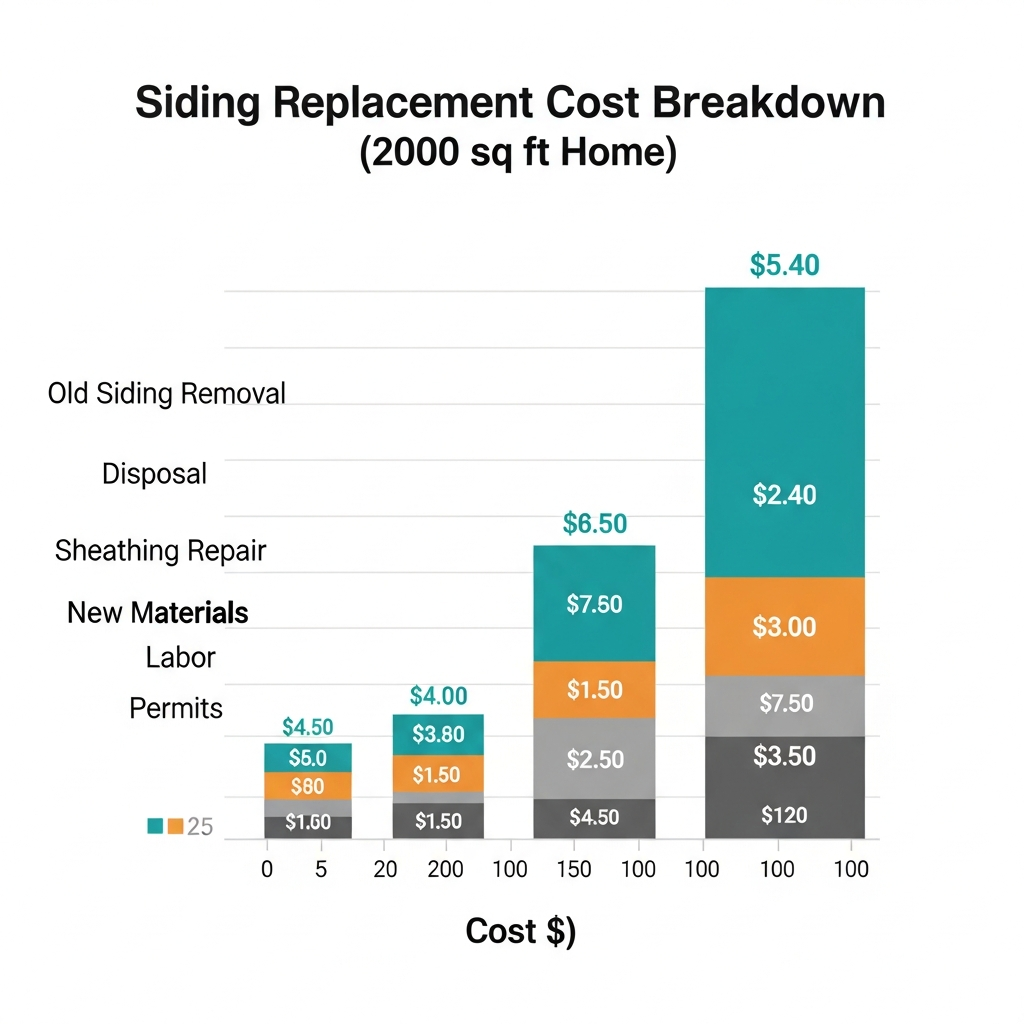
Example Cost Sheet: Full Siding Replacement on a 2,000-Square-Foot Home
Here's a realistic scenario. Two-story, 2,000-square-foot home in Virginia with moderate complexity, replacing old wood siding with mid-grade vinyl siding.
| Line Item | Cost |
|---|---|
| Old wood siding removal (2,000 sq ft × $1.40/sq ft) | $2,800 |
| Disposal, hauling, dumpster | $800 |
| Sheathing repair (estimated 15% of area × $3.00/sq ft) | $900 |
| House wrap (Tyvek) | $550 |
| Vinyl siding panels — mid-grade (2,200 sq ft incl. waste × $2.10/sq ft) | $4,620 |
| Trim, J-channel, corners, starter strips | $1,400 |
| Installation labor (2,000 sq ft × $2.20/sq ft, VA rate) | $4,400 |
| Scaffolding (2-story) | $400 |
| Permits | $350 |
| Total Replacement Cost | $16,220 |
| Cost per square foot (full replacement) | $8.11/sq ft |
Example based on 2026 pricing in northern Virginia. Wood-to-vinyl replacement. Actual costs will vary.
Notice the sheathing repair line item — $900 for 300 square feet of damaged OSB that was hidden behind the old wood siding. This is the kind of surprise that shows up on 30–40% of replacement projects involving older homes. Smart contractors include a contingency line in their estimates for exactly this scenario.
Is Siding Replacement Worth the Investment?
In almost every scenario, yes — if the timing is right. Siding replacement is one of the highest-ROI renovation projects a homeowner can undertake. According to Remodeling Magazine's Cost vs. Value report, vinyl siding replacement recoups 67–69% of the project cost at resale, and fiber cement siding replacement recoups 70–77%.
But ROI isn't the only consideration. Damaged or aging siding creates cascading problems: moisture infiltration that leads to mold and rot in the wall cavities, reduced energy efficiency as building insulation gets wet and compresses, pest entry points for insects and rodents, and declining curb appeal that makes the whole house look neglected. Waiting too long to replace failing siding can turn a $12,000 siding project into a $25,000 siding-plus-sheathing-plus-framing project.
Signs Your Siding Needs to Be Replaced
Not sure whether you need replacement or just a repair? Here are the indicators that full replacement is the right call:
Widespread warping or buckling. A few warped panels can be replaced individually. But if warping appears across multiple walls, the underlying substrate or installation has failed.
Extensive fading or color loss. UV degradation that covers most of the house means the siding's UV stabilizers are exhausted. New paint won't fix structural UV damage in vinyl — the material itself becomes brittle.
Moisture behind the siding. If you see mold, mildew, or water stains on interior walls, or if a moisture meter reading behind the siding shows elevated levels, the weather barrier has been compromised. This usually means full removal, sheathing inspection, and fresh house wrap.
Rising heating or cooling bills. Old siding with failed caulking and gaps lets conditioned air escape and outdoor air infiltrate. If your energy bills have crept up without explanation, failing siding could be contributing.
Age. If your siding is past its expected lifespan — 20+ years for vinyl, 15+ for wood, 30+ for fiber cement — proactive replacement before failure occurs lets you control the timeline and budget rather than reacting to an emergency.
For smaller damage that doesn't justify full replacement, see our siding repair cost calculator.
Siding Replacement Cost vs. Painting
Homeowners with aging but structurally sound siding sometimes ask: should I just paint instead of replacing? Here's the quick comparison:
Exterior painting costs $1.50 to $4.00 per square foot for an average home — roughly $3,000 to $8,000 for a 2,000-square-foot house. It lasts 5 to 10 years depending on the paint quality, the surface condition, and weather exposure. Siding replacement costs $7,000 to $30,000+ but lasts 20 to 50+ years. If you're planning to stay in the home for 10+ years, replacement almost always wins on a cost-per-year basis. If you're selling within 3–5 years and the siding is structurally sound, paint might be the smarter short-term investment.
Frequently Asked Questions About Siding Replacement Cost
How much does it cost to replace siding on a 2,000-square-foot house?
For a 2,000-square-foot home, siding replacement costs $9,000–$17,000 for vinyl, $14,000–$29,000 for fiber cement, and $15,000–$31,000 for James Hardie. These totals include removal of old siding, disposal, new material, labor, and permits.
How much does it cost to reside a 1,500-square-foot house?
A 1,500-square-foot home costs $6,750–$12,750 for vinyl siding replacement and $10,500–$21,750 for fiber cement replacement including removal and disposal. Use our calculator above for a state-specific estimate.
How much does siding cost per square foot to replace?
Including removal and installation, siding replacement costs $4.50–$8.50/sq ft for vinyl, $7.00–$14.50/sq ft for fiber cement, and $7.50–$15.50/sq ft for James Hardie. These per-square-foot figures include tear-off, disposal, and new installation.
Is it worth replacing siding on a house?
Yes, in most cases. Siding replacement recoups 67–77% of the project cost at resale depending on material. More importantly, failing siding allows moisture damage, pest entry, and energy loss that create expensive secondary problems if left unaddressed.
Can you install new siding over old siding?
Sometimes. Vinyl can sometimes be installed over existing vinyl or aluminum, saving $1,500–$3,000 in removal costs. However, this prevents sheathing inspection, adds wall weight, and may void the new siding warranty. Most professionals recommend full removal, especially on homes 20+ years old.
What is the cheapest siding to replace?
Vinyl siding is the cheapest replacement option at $3.50–$7.00/sq ft installed. Aluminum siding is similarly priced. Engineered wood (LP SmartSide) at $4.50–$9.00/sq ft is the next most affordable option with a wood-look aesthetic.
How long does siding replacement take?
A typical vinyl siding replacement on a 2,000-square-foot home takes 3 to 5 working days. Fiber cement and Hardie board installations take 5 to 8 days due to heavier material and specialized cutting. Weather delays, sheathing repairs, and complex architecture can extend the timeline.
Is siding replacement tax deductible?
Generally no — siding replacement on a primary residence is not tax deductible as a home improvement expense. However, if you install energy-efficient insulated siding, you may qualify for energy efficiency tax credits under the Inflation Reduction Act. Consult a tax professional for your specific situation.
Why is siding replacement so expensive right now?
Siding replacement costs increased 15–25% between 2021 and 2023 due to material price increases (PVC resin, cement, lumber), supply chain disruptions, and higher labor rates. Prices have stabilized in 2025–2026 but remain above pre-pandemic levels.
Should I replace my siding before selling my house?
If your siding is visibly damaged, faded, or outdated, yes. New siding dramatically improves curb appeal and helps homes sell faster. The 67–77% cost recovery at resale makes it one of the better ROI renovations. If the siding is in decent shape but just dated, consider whether painting might be sufficient.
Ready to Estimate Your Siding Replacement?
Use our free calculator above to get a state-specific estimate including removal, disposal, and new installation. Then compare materials to find the best value for your home and budget.
Related Siding Calculators
Vinyl Siding Cost
Most affordable replacement option
Hardie Board Siding Cost
Premium fiber cement replacement
Siding Repair Cost
Repair vs. replace analysis
Siding Cost Calculator
Compare all materials side by side
House Siding Cost
Complete guide to siding a house
Siding Installation Cost
Labor and installation breakdown
Data Sources & Methodology
📊Bureau of Labor Statistics (BLS) — Occupational Employment and Wage Statistics (OEWS), OCC 47-2211 & 47-2031
🏠National Association of Home Builders (NAHB) — Construction Cost Survey, 2024-2026 data
🏭James Hardie Corp — Published product pricing and warranty specifications
🌲Western Red Cedar Bureau — Cedar siding grade pricing and specifications
🔧Active contractor pricing surveys — 50-state coverage, updated quarterly
All cost data is updated quarterly. Last comprehensive update: Q1 2026.
Home Exterior Cost Analyst
Sarah Brennan
Sarah Brennan is a construction cost researcher specializing in exterior building envelope systems. With 14 years of experience in residential construction estimating, she transitioned from managing siding installation crews to independent cost research. Her data draws from the Bureau of Labor Statistics, NAHB construction cost reports, manufacturer pricing databases, and active contractor surveys across all 50 states. Sarah is a Certified Construction Specifier (CCS) through the Construction Specifications Institute.
Important Disclaimer
The cost estimates provided by SidingCosts.com are for informational and educational purposes only. Actual siding costs vary based on local labor rates, material availability, site conditions, contractor pricing, and other factors not captured by this calculator. These estimates should not be used as a substitute for professional contractor quotes. SidingCosts.com is not a licensed contractor and does not provide installation services. Always obtain at least 3 written quotes from licensed, insured contractors in your area before starting any siding project. Data sources include the Bureau of Labor Statistics (BLS), National Association of Home Builders (NAHB), and manufacturer published pricing. Last updated: 2026.